
Writer API
Writer API is an enterprise-level AI service platform
 Xiaomi MiMo Open Platform
Xiaomi's self-developed API service platform for developers
Official website: https://platform.xiaomimimo.com/
I usually develop small backend tools and often need to call large models to generate code and process multimodal data. I’ve hit quite a few pitfalls before: some platforms only have a web chat box and can’t be connected to local programming tools; some have cumbersome API application processes, and by the time I got the Key the project schedule had already been delayed; and some third-party proxy platforms are unstable — calls break off halfway and requests have to be resent over and over. It was only after I came across Xiaomi’s self-developed MiMo Open Platform that many of these practical problems were solved.
Beginners most easily fall into three misconceptions when using this platform: first, don’t treat it as an ordinary chat-based LLM platform — it doesn’t even have a chat entrance, as it is built specifically for developers to integrate via API, so anyone searching for ages for a chat box will probably be confused; second, don’t assume only text models are available — its **MiMo-V2.6** flagship model supports full modality, voice and other scenarios, beginners simply haven’t found the corresponding interfaces; third, don’t jump straight to the top-tier plan — the basic tier is enough when you’re starting out, and wasting Token quota is money down the drain.
The platform’s core practical value lies mainly in its developer friendliness: it is developed by Xiaomi officially, so its stability is far more reliable than third-party proxy platforms — there’s no sudden service shutdown; the **API Key** application process is extremely simple — just fill in your developer identity and you can use it right away, without complicated qualification reviews; it also connects directly with mainstream programming tools, so you don’t need to write adaptation code yourself, saving a lot of extra work.
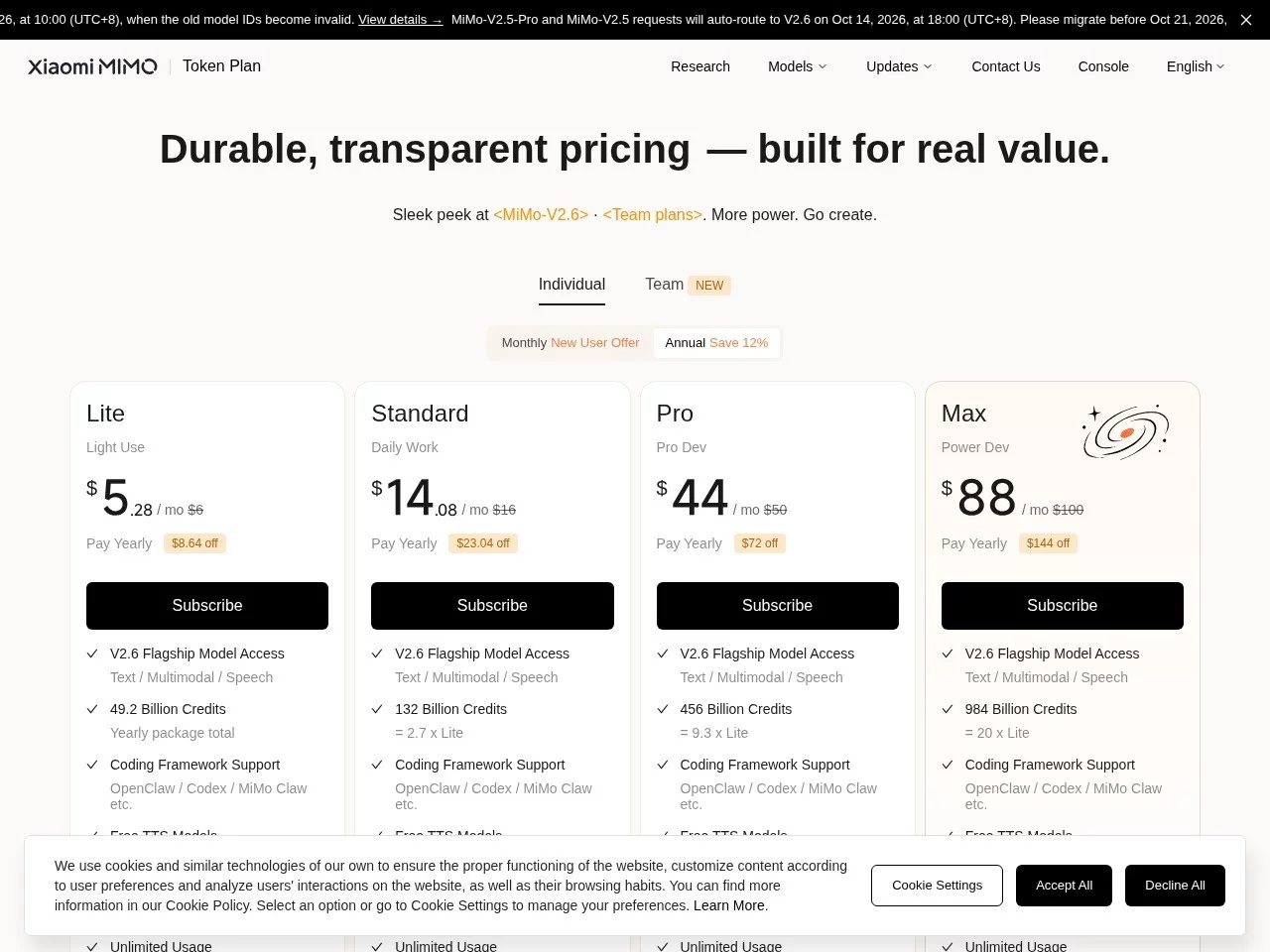
In terms of actual functionality, the most striking is MiMo-V2.6’s code generation capability: its Python and Go code accuracy in Chinese scenarios is higher than comparable platforms, with coherent logic and rarely any garbled output or logic flaws — after a few tweaks it can plug straight into a project; the TTS voice model settings are thoughtful — during certain night hours consumption is only 0.8 times the usual rate, so if you need to generate voice content, timing your usage can save quite a few Tokens; plans are divided into four tiers — Lite, Standard, Pro and Max — based on call volume, so just choose according to your project scale, and continuous annual subscriptions come with an extra discount, better value than one-off purchases.
Its advantages over comparable platforms are also obvious: most third-party platforms charge separately for TTS or offer no time-based discounts, whereas this platform’s night discount is a genuine cost saving; the supported mainstream programming tools need no self-adaptation, whereas many other platforms require manually adjusting interface parameters, an easy trap for beginners; and being an official product means its API response speed is faster than proxy platforms, with no call-latency issues — which matters a lot for projects on a tight schedule.
Here are a few tips to avoid pitfalls: beginners shouldn’t pick the highest tier at the start — test your project’s needs with the Lite tier first and upgrade once call volume stabilises, so you don’t waste unused Tokens; remember the TTS discount hours — they don’t apply all day, so don’t use it casually outside the discount window; store your API Key in local encrypted storage and don’t share it with others, otherwise abuse will consume a lot of quota; make sure the compatible programming tools are the latest versions — older versions may fail to connect to the interfaces; Token subscriptions are billed by call volume, so don’t buy more quota than you need, to avoid waste.
Those suited to this platform are mainly developers who need to integrate large models into their own applications or programming tools, especially for code generation and multimodal content processing; ordinary users looking for a chat-based LLM won’t find this platform suitable, because it has no personal chat interface — its core is providing API services for development.