Zhipu Open Platform
Zhipu Open Platform is an AI project integration platform for developers
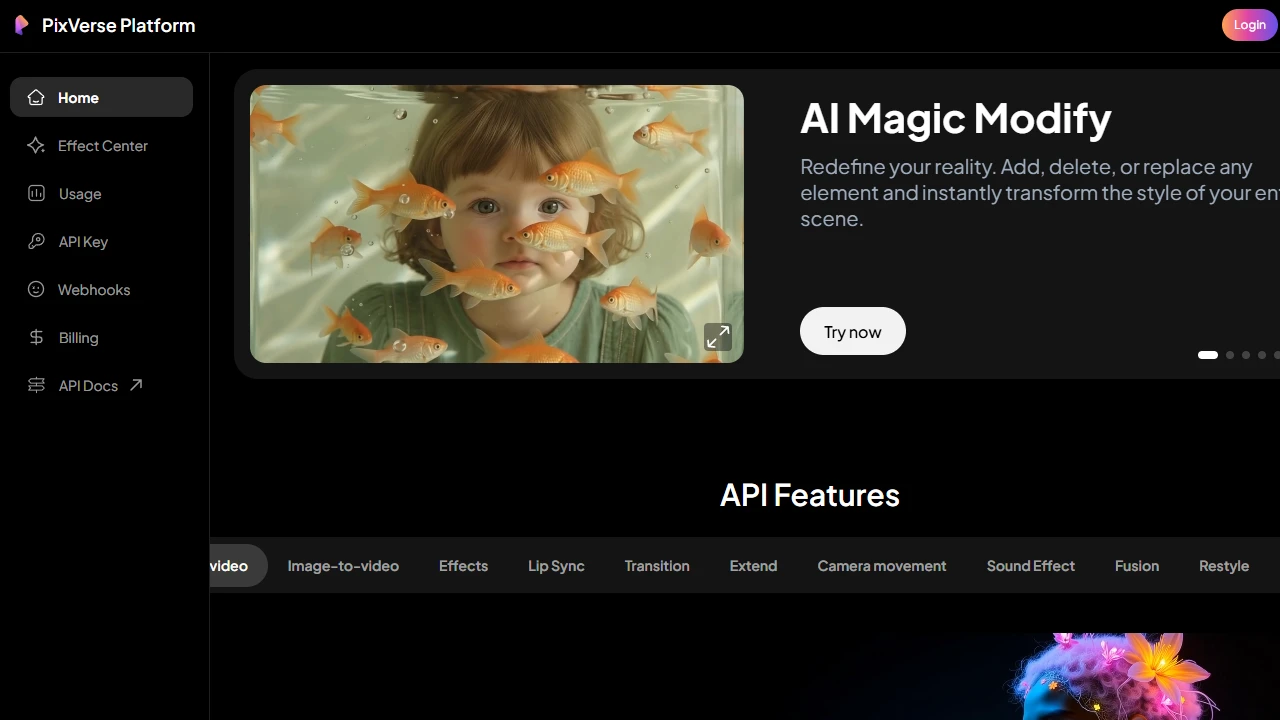
 PixVerse Open Platform
 is a premium video API integration platform
Official Website: https://platform.pixverse.ai/
We previously covered PixVerse’s web version — easy enough for everyday users — but what many people don’t know is that it also has a dedicated open platform aimed at developers and enterprises. Simply put, it wraps PixVerse’s video generation capability into APIs, so developers can call it directly from their own websites, apps and mini programs. Users don’t need to jump over to the PixVerse page — AI videos can be generated right inside your own product. For teams that want to build AI video features, rather than training models from scratch and building generation services yourself, it makes far more sense to plug into a mature platform’s APIs directly — the time and cost saved are considerable.
The open platform is positioned completely differently from the web version. The web version is a tool for people: you manually write prompts on the page and click generate. The open platform is for programs: generation requests are submitted to PixVerse’s servers via API, which then return the generated video results to you. For programmers, this is essentially video generation turned into an on-demand service that can be integrated into business processes. Whether you are building a content creation tool or adding an AI feature to an existing product, the approach is the same: connect the API and you are ready to go.
The core of the open platform is its APIs — you initiate requests through code, submit a text description or an image, and retrieve the results once video generation completes. The integration process is fairly standard overall: developers first register an account and obtain access credentials, then submit generation tasks following the documentation. Since it is an asynchronous task, video generation takes some time. The platform returns a task identifier; you check the task status after a while, and once it shows completed, you get the video file URL. This asynchronous mechanism works much like mainstream AI APIs, and experienced backend developers can get it running within half a day.
Integrating the open platform essentially adds a module to your product that calls external AI capabilities. The front-end interface and user flows remain your own; only the “generate video” step is handed over to PixVerse. This way, your product doesn’t have to shoulder the heavy costs of model training and server computing power, yet can offer AI video capabilities to users straight away — a very pragmatic technical path for many small and medium-sized teams.
The most direct value of the open platform is helping you quickly add AI video generation to an existing product without the hassle of building from scratch. Products that want AI features in content creation tools can add an “AI generate video” entry in their own editors, so users write a description and get the video right inside the app instead of jumping to another website; e-commerce platforms can add AI dynamic display to product images, letting users see what a product looks like in video form; teams building education or marketing tools can also hook AI video into their workflows, giving customers a new creative means. For teams that want AI video features but don’t want to train their own models, this is a very practical integration point.
From a developer’s perspective, the open platform’s documentation and API specifications are fairly clear, so the integration process follows well-trodden steps rather than trial and error. The logic of task creation, status querying and result retrieval is all clear, and errors can be diagnosed from the returned information. For backend engineers, it is a relatively friendly integration experience that won’t leave you stuck for long. Billing is usage-based — you pay for what you use — so for projects just starting out with low call volumes, costs stay controllable, with no worry of carrying high fixed overheads from day one.
To make good use of the open platform, several points need thinking through in advance. The first is volume: video generation takes time, and a single video requires waiting. If your product needs batch generation, you must work out how tasks queue up and how to show waiting progress to users — don’t leave people idly waiting. The second is cost estimation: although billing is usage-based, if your product has many users making frequent calls, work out the costs beforehand rather than reacting only when the bill arrives — do the sums based on estimated volumes before you start. The third is expectation management: AI video generation is inherently random and doesn’t always nail it on the first attempt, so it is best to give users a regenerate option in your product rather than treating generation results as deterministic output.
There is also a technical point: the files involved in video generation are fairly large, so once you have retrieved the results, you need to consider the storage and delivery of video files — users shouldn’t have to wait too long or face frequent loading failures. Pay attention to API authentication and key management as well: don’t hard-code credentials in your code, to prevent leaks and malicious calls. Overall, the integration is not complicated, but only by handling these engineering details before launch can your product run reliably, rather than falling apart as soon as user traffic grows.
For developers and teams looking to build AI video-related products, the PixVerse Open Platform offers a ready-made capability foundation. No need to train your own models or set up computing infrastructure — the generation capability is packaged as an API, ready to plug into your own application. The R&D time and computing costs saved are especially significant for small and medium-sized teams. Read through the integration documentation, billing model and technical details in advance, think through how to apply them to your business scenario, and you can bring AI video capabilities into your product fairly smoothly. Save the URL — log in to the platform to explore integration whenever you need it. It is a technical resource worth bookmarking.