Meta Llama API
Practical Experience and Pitfalls of Using Meta Llama API
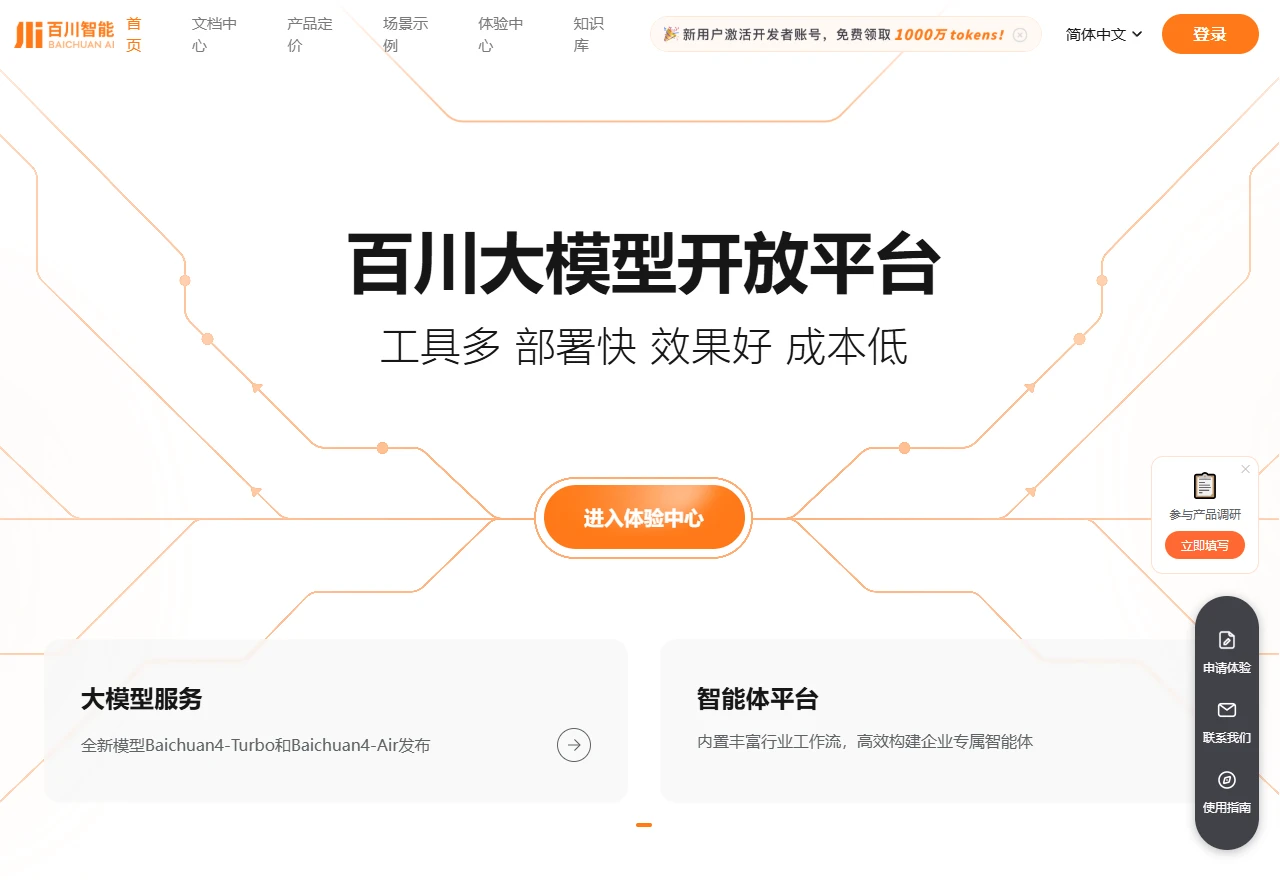
 Baichuan Large Model Open Platform
Baichuan Intelligence offers open commercial AI large model APIs to developers
Official website: https://platform.baichuan-ai.com/
Over the past two years, more and more large language model open platforms have emerged in China, and Baichuan Intelligence is one of the more representative ones. Its open platform is designed for developers and enterprises to integrate via APIs, encapsulating its own large model capabilities into interfaces that developers can directly call in their products and applications. For teams that want to add AI functions but do not want to train models from scratch, such platforms offer a practical option: no need to invest significant funds in computing power, no need for complex model deployment, just apply for an API key, connect the interface, and you can use the large model in your business.
Baichuan Intelligence develops general-purpose large models, and its Baichuan series models perform well in Chinese language understanding and generation, covering common AI scenarios such as text dialogue, content generation, and intelligent Q&A. The open platform makes this set of capabilities available to the public, providing them via standard APIs. Like many large model platforms, you write code to call the interface, submit your questions or instructions, the platform returns the model’s response, and you display it to users in your own interface. The entire integration process is developer-friendly for back-end developers, and it can be completed by following the documentation.
The core of the open platform is the API, which is used to call the model via code requests. After developers register an account, create an application, and obtain access credentials, they can send requests according to the interface documentation. Generally, you submit information such as your instructions and context, and the model returns results after processing. Since large model inference takes a little time, there will be a waiting period for the interface response; just handle this properly in your code. The overall integration method is basically the same as mainstream large model platforms; those with API calling experience can get started quickly, and it is common to complete a simple call in half a day to a day.
Integrating with the open platform essentially adds a module to your product that calls external AI capabilities. Front-end interaction and business logic remain your own; only the step of “letting AI understand and respond” is handled by Baichuan’s model. This way, the product does not need to bear the cost of model training and inference servers, and can directly provide large model capabilities to users. For many projects that want to add AI functions but have a small technical team, this is a cost-controllable path.
The capabilities provided by the open platform can cover many actual business needs. For intelligent customer service, it can be used for multi-turn dialogues to answer users’ questions and reduce the pressure on manual customer service; for content products, it can be used for copywriting generation and abstract extraction, helping users quickly produce content; for knowledge Q&A and data organisation, it can be integrated into tools, allowing users to ask questions in natural language and get answers quickly. For teams that want to add AI functions to existing products, these are directly implementable uses.
The model’s understanding and generation capabilities in Chinese scenarios are one of its major advantages. The model handles Chinese contexts and expression habits more naturally, making it more convenient for businesses targeting Chinese users. Whether it is a chat assistant for C-end users or a document processing tool for B-end enterprises, it can be considered as a base. Of course, whether a business can use it well depends on prompt design and how the business cooperates with the model; it is not just about integration, but requires a little tuning.
To use the open platform well, several points need to be clear in advance. The first is cost: large model calls are charged by token or per call, and costs will increase as business volume grows. Before starting, calculate the cost based on the estimated call volume to avoid being shocked by the monthly bill. The second is effect expectation: large models have randomness, and the same question may get different answers at different times; it is not deterministic output, so appropriate guidance and fallback should be provided in product design. The third is latency: model inference takes time, so experience issues should be considered for scenarios with very high-frequency interactions and high requirements for response speed.
There are also engineering details: keep API keys and credentials secure, do not hardcode them in code or leak them to public repositories to prevent malicious theft. Handle timeouts and retries properly in requests; when there are network fluctuations or occasional service anomalies, the code should handle them, not just crash when users encounter problems. These are not difficult aspects of the interface itself, but engineering details that need to be handled before launch. When done properly, the product will run stably and not have issues when there is traffic.
For developers and enterprises that want to add AI functions and use large model capabilities, Baichuan Large Model Open Platform provides a ready-made capability entry. No need to train models yourself or build inference services; just integrate the interface into your application to use it, which is very convenient for small and medium-sized teams. Study the documentation, billing, and model capabilities clearly, and figure out how to use them in combination with your own business, then you can smoothly integrate large model capabilities into your product. Save the website, log in to the platform to view documentation and apply for API keys when needed; it is a technical resource worth paying attention to.