Huawei Pangu
A practical experience review of the Huawei Pangu large model service
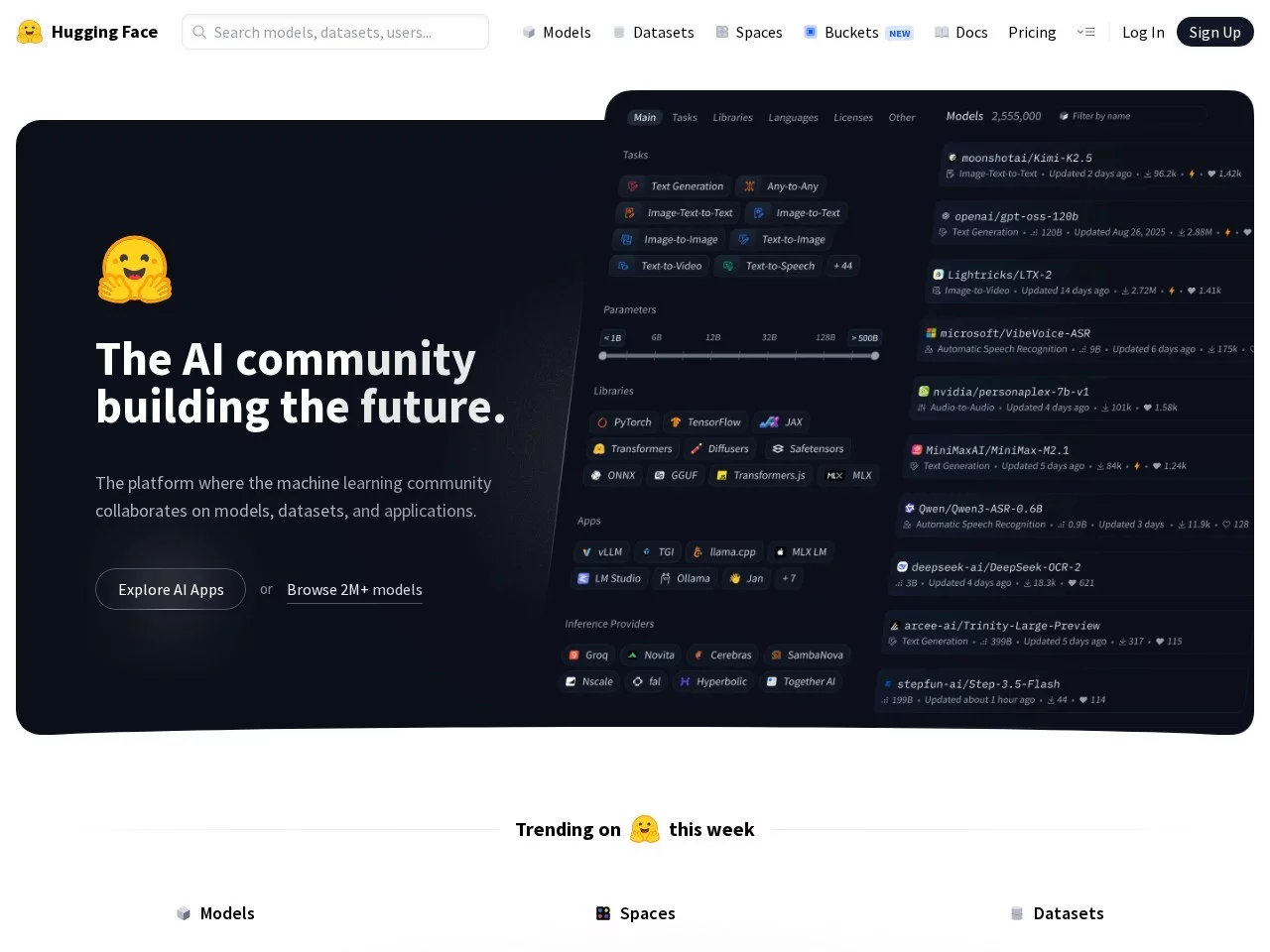
 Hugging Face
 is a premium platform for AI model hosting and APIs
Official Website: https://huggingface.co/
Back when I was tinkering with AI mini-tools, I was always looking for an official channel to call models directly — not one of those chatbot pages that only support online chatting, but a community where you could pull open-source models to run **inference**. I hit quite a few pitfalls before finding this site.
Most newcomers are confused at first — the screen is full of model cards but there is no obvious entry point. People often assume it is a ChatGPT-style chat interface, then click around endlessly without finding a dialogue box; that is the most common misconception. It took me a while to realise that the core of this site is model hosting and official API calls, not a chat tool. The real entry point is tucked away in the “Inference” tab on a model’s detail page, or in the dedicated API documentation area — not the kind of thing you spot at a glance.
The most practical thing about this site is that it truly hosts a massive number of open-source models, covering almost every AI task you can think of, from text generation and image classification to speech-to-text. There is no need to set up your own server to train models — just call them via the official API, which saves you all the hassle of local deployment and spares you from dealing with complex model compatibility issues.
In daily use, I prefer to **find models by task category** instead of blindly searching keywords. For example, to build a small text-summarisation feature, just click the “Tasks” category on the page and pick text summarisation — everything that comes up fits that need, and each model comes with ready-made parameter examples, so you do not have to dig through piles of scattered documentation. API calls are simple too: send an input in the standard format and get the result straight back. Stability is far better than going through third-party proxies — no constant rate limiting or abnormal responses.
Compared with other similar communities, this site’s advantages are obvious. I once used another small community that had only a handful of popular models; for many useful ones you had to hunt for unofficial calling channels yourself, and API calls often lagged, with the added worry about third-party stability. This site is different: the models are all hosted in-house, with the official team providing inference services directly. Calls are fast, and you can find calling examples shared by other developers in the community, so you do not have to learn through trial and error.
There are also a few pitfalls to watch out for, all of which I have personally run into:
One more small detail: many models on this site have already been format-optimised, so you do not need to handle data adaptation yourself. For example, for text input you can simply pass a string without converting it into a specific tensor format. It is very beginner-friendly — no need to wrestle with low-level technical details; just focus on your own business logic.
The people this site suits are actually quite clear: developers who want to build AI mini-tools or app plugins and do not want to spend time training models, just running inference with ready-made ones; and newcomers to AI development who do not want the hassle of local deployment — with the API you can get things running straight away, which removes a lot of the entry barriers.
By the way, I have tried calling a model’s official inference endpoint directly — no need to set up your own server. That part is truly hassle-free: you do not have to worry about model version updates, as the official team maintains them automatically. All you need to do is focus on the features you want to build.