1000logos
A website focused on brand identity and logo design, collecting all kinds of logos from around the world.
 Logotyp
A website providing global Logo resources
Official website: https://logotyp.us/
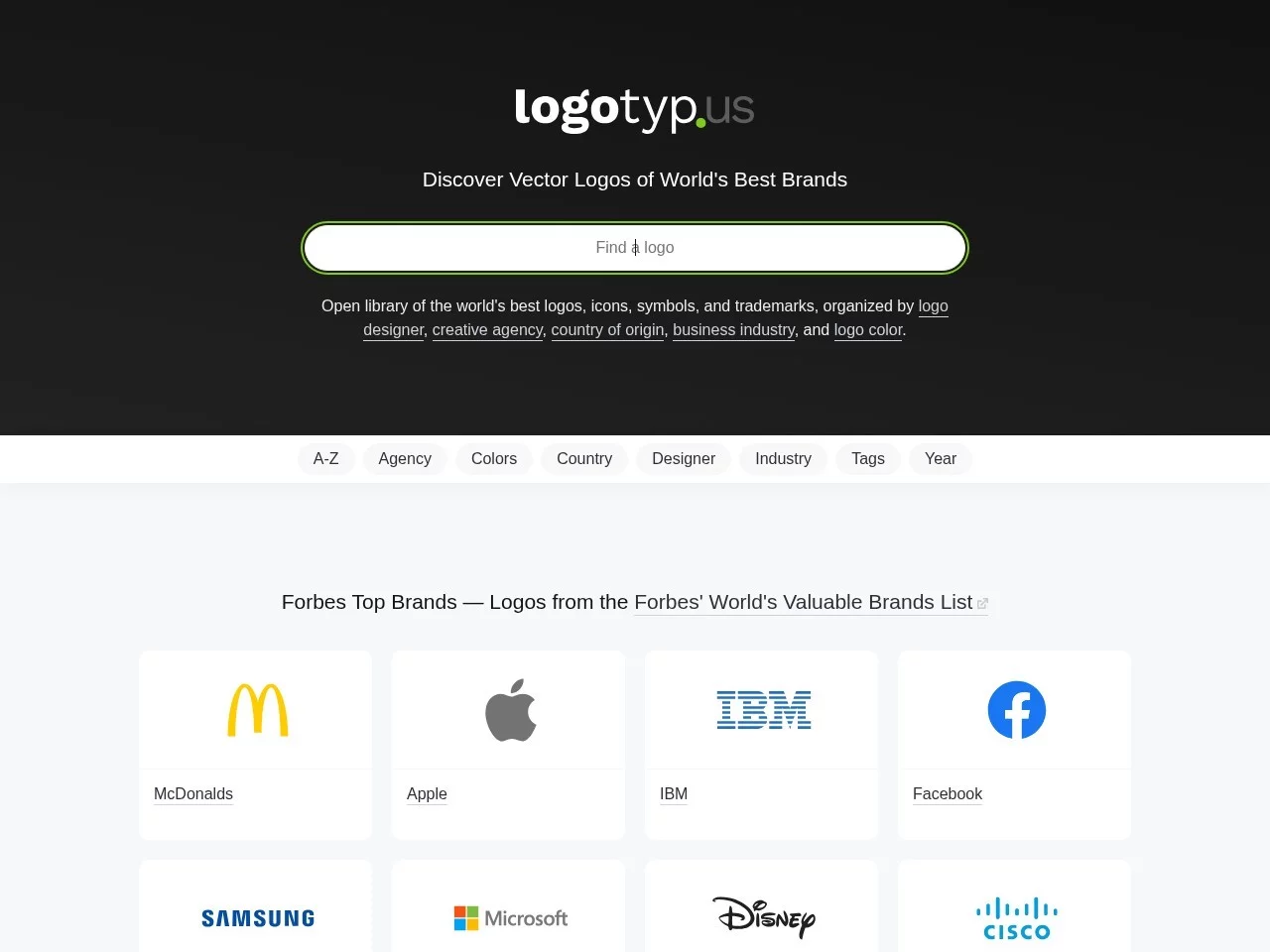
Staying up late revising drafts, the client suddenly requests a logo for an overseas brand. After searching the entire internet, you only find blurry screenshots that get even more pixelated when enlarged, and putting them in your PPT directly ruins the quality of the whole proposal. I believe many designers have experienced this scenario. Logotyp is a platform built to solve such problems. It focuses on integrating global Logo resources, combining search, download, and information lookup into one interface, making the originally tedious process of finding images clean and efficient. Whether it’s designers rushing for projects, enterprises checking brand guidelines, or design enthusiasts browsing daily, everyone can find a convenient use here.
Different from common image sites, Logotyp’s resources are organized around the core of “brands”. It covers logos from multiple countries and industries worldwide, with content updated in real time. New brands and logos can quickly enter the retrieval scope, which is one of the reasons for its good reputation among users.
People opening Logotyp for the first time hardly need any learning cost. The entire platform revolves around three steps: “Find it—Understand it—Use it”, with clear tool support provided for each step.
If you already know the brand name clearly, you can directly input the keyword to get precise results; if you only vaguely remember what a certain Logo looks like, you can also browse step by step according to alphabetical order, locating resources like flipping through a dictionary. The two paths complement each other to meet search needs of different familiarity levels.
The platform provides vector format download service, which has a great impact on practical work: vector files can be scaled infinitely, remaining clear when printed on business cards and unchanged when placed on display boards or roll-up banners. After getting the materials, you don’t need to spend time tracing or redrawing, and can directly use them in design projects.
Clicking on any Logo to enter the detail page, you can see far more than the graphic itself, including:
For those making brand research reports, a detail page is almost like a condensed data card; for those at the execution level, color values and guideline information can directly reduce rework.
The shortcoming of many image-finding platforms is that “you can only search if you know the name”. Logotyp fills this gap with a category tag system. Resources can be browsed by industry attributes or filtered by country, with a dedicated China category to quickly focus on domestic brands; there are also two dimensions particularly friendly to designers, categorized by designer and design agency. If you want to systematically study the work style of a certain designer or company, you can browse the full content by clicking through the tags.
Classification by color is another source of inspiration. When receiving a project with red as the main visual, browsing a collection of logos in the same color family is often easier to find a sense of color matching and shape than imagining from scratch. These tags intersect with each other, making browsing without a clear goal also rewarding.
In addition to being a material library, Logotyp also serves as a professional design reference. The platform has collected the design concepts and evolution history of many classic logos, sorting out the overlooked cultural significance behind the logos. New designers can use this to understand “why a good logo is good”, and enterprises can also find reference methodologies when doing brand sorting.
For brand enthusiasts, browsing these cases is a pleasure in itself. From the iteration of logos, you can see changes in the business environment and the flow of aesthetic trends, which is content that ordinary image libraries cannot provide.
Yes. The downloaded vector files can be opened and used in common design and office software. Even without secondary editing, directly scaling and inserting into documents will not cause quality loss.
Core information that enterprise users care about, such as standard color values, industry attributes, usage guidelines, etc., are all presented on the detail page, which is sufficient to support brand research and guideline checking.
Very suitable. Multi-dimensional tags such as industry, designer, design agency, and color are browsing entrances themselves. Combined with the evolution history content of classic cases, even without a task, it can be read as design information.
From precise retrieval, vector download, to color value lookup and case studies, Logotyp has completed a full loop of what a Logo platform should do: the interface remains concise, resources cover the whole world, and content is continuously updated. Next time you encounter the problem of “can’t find a clear logo”, you might as well visit it directly and leave time for the truly important design process.