
SportsLogos.Net
An online museum dedicated to the history of sports logos and uniforms
 DiceBear
 is an open-source avatar generator designed specifically for quickly generating customizable SVG avatars for web, mobile, or any scenario requiring user avatars.
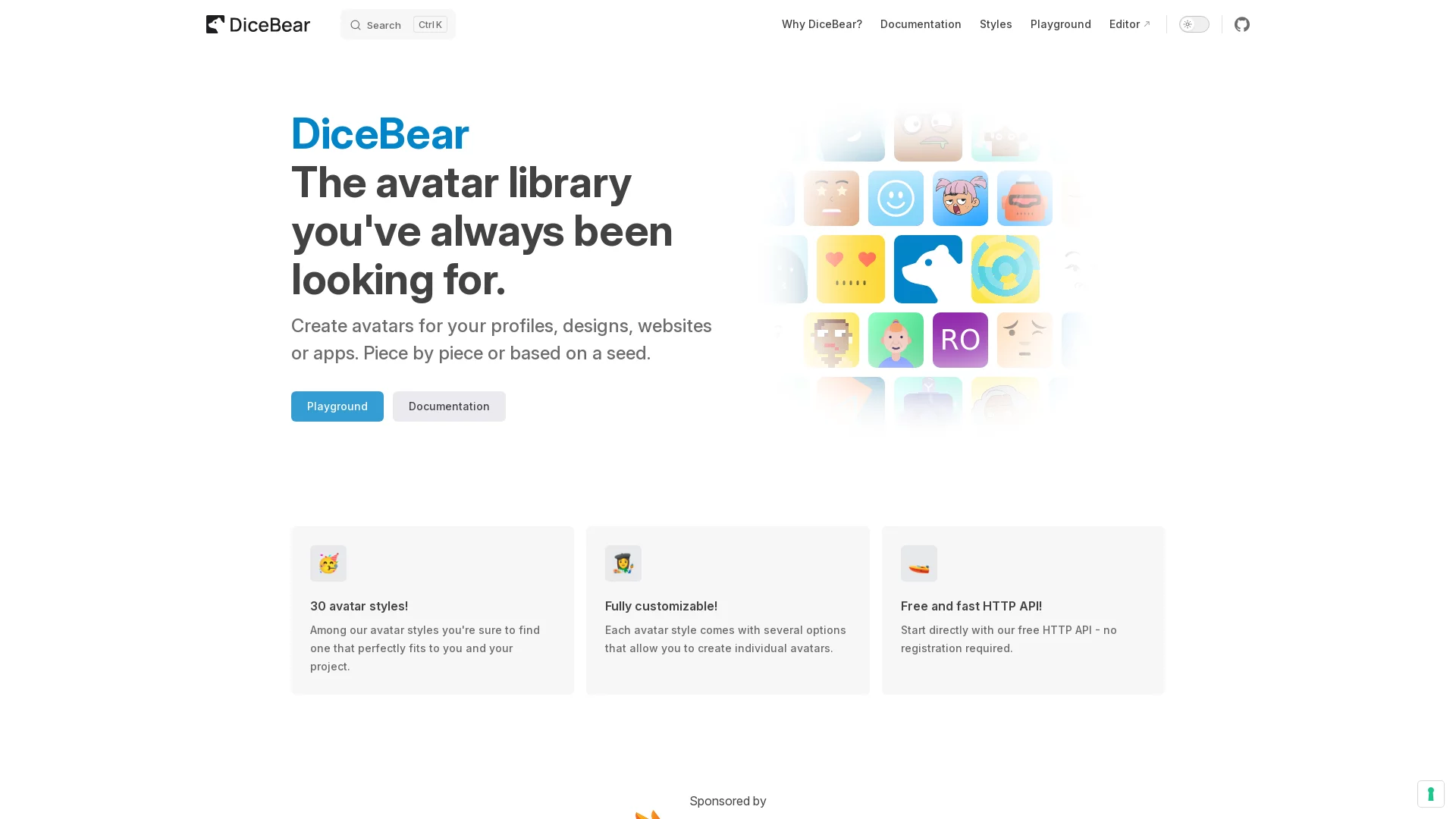
Product developers have all encountered similar awkward situations: when new users register, the empty default avatar on the interface instantly makes the whole page lifeless; forcing every user to upload photos would raise the usage threshold. DiceBear is an open-source avatar generation library designed for such pain points — it has over 25 built-in style templates, covering various art forms such as cartoon, pixel, geometry, hand-drawn, etc. Developers only need to pass a simple parameter or a seed value to instantly generate a beautiful, unique and reproducible avatar. Personal images on social platforms, user identifiers in enterprise internal systems, and UI design for web and mobile applications can all benefit directly from it.
Official website: https://www.dicebear.com/
For individual developers, it is a ready-to-use visual patch; for design teams, it is a reliable assistant to unify product style. Below, we break down its practical value from three perspectives: function, mechanism and integration.
25+ styles mean ample choices: products targeting a younger audience can choose cartoon or hand-drawn styles, retro game projects suit pixel styles, and geometric styles are ideal for pursuing a simple and modern interface. Switching between different styles is low-cost — changing a set of parameters can replace the overall visual tone without preparing new design resources.
DiceBear’s customization is fine-grained — the color, size and direction of components such as hairstyle, eyes, mouth, accessories can be adjusted separately. This means it is not just “random image generation”, but can align with brand color schemes and design specifications to produce precise personalized outputs.
This is its design most praised by developers. As long as the seed value is the same, the generated avatar will be exactly the same no matter when, where or on which device. Just store the seed in the database — the avatar image itself does not need to be saved to disk, making data persistence and cross-platform synchronization very lightweight.
DiceBear uses modern JavaScript/TypeScript interfaces, compatible with mainstream front-end frameworks such as React, Vue, Angular, and can also be called in back-end environments. The official provides abundant documentation and sample code, making the integration process almost barrier-free.
A notable detail: since generation is completely done on the client side, the server only needs to store the seed string, making storage and bandwidth costs almost negligible — this is especially friendly for products with rapidly growing user bases.
Default avatars for social and community products, user identifiers in enterprise internal systems, placeholder images in prototype demos, and visual elements in UI design drafts are all typical use cases. It is applicable to any scenario that requires “batch, consistent and beautiful” avatars.
Yes. You can either use a unique seed to generate a complete avatar at once, ensuring high reproducibility, or assemble hairstyles, facial features and accessories item by item through parameters, with the customization depth fully controlled by developers.
No. The generation process is completed on the browser side, avoiding additional image requests; combined with the seed mechanism to generate on demand, it hardly brings any burden to front-end performance.
When choosing an avatar solution, you may wish to measure it by three criteria: whether there are enough styles, whether customization is detailed enough, and whether integration is lightweight enough. DiceBear performs solidly in all three aspects — with 25+ styles as a base, component-level parameters for fine-tuning, one line of seed value to ensure consistency, plus the expansion freedom brought by its open-source nature, it is sufficient to support various needs from personal projects to enterprise products.
If your product is troubled by “too monotonous default avatars”, it is recommended to try several style sets on the official website first, experience the actual effects of different template and parameter combinations, and then decide whether to introduce it — real experience is often more convincing than documentation.