ICiba
ICiba Online Translation
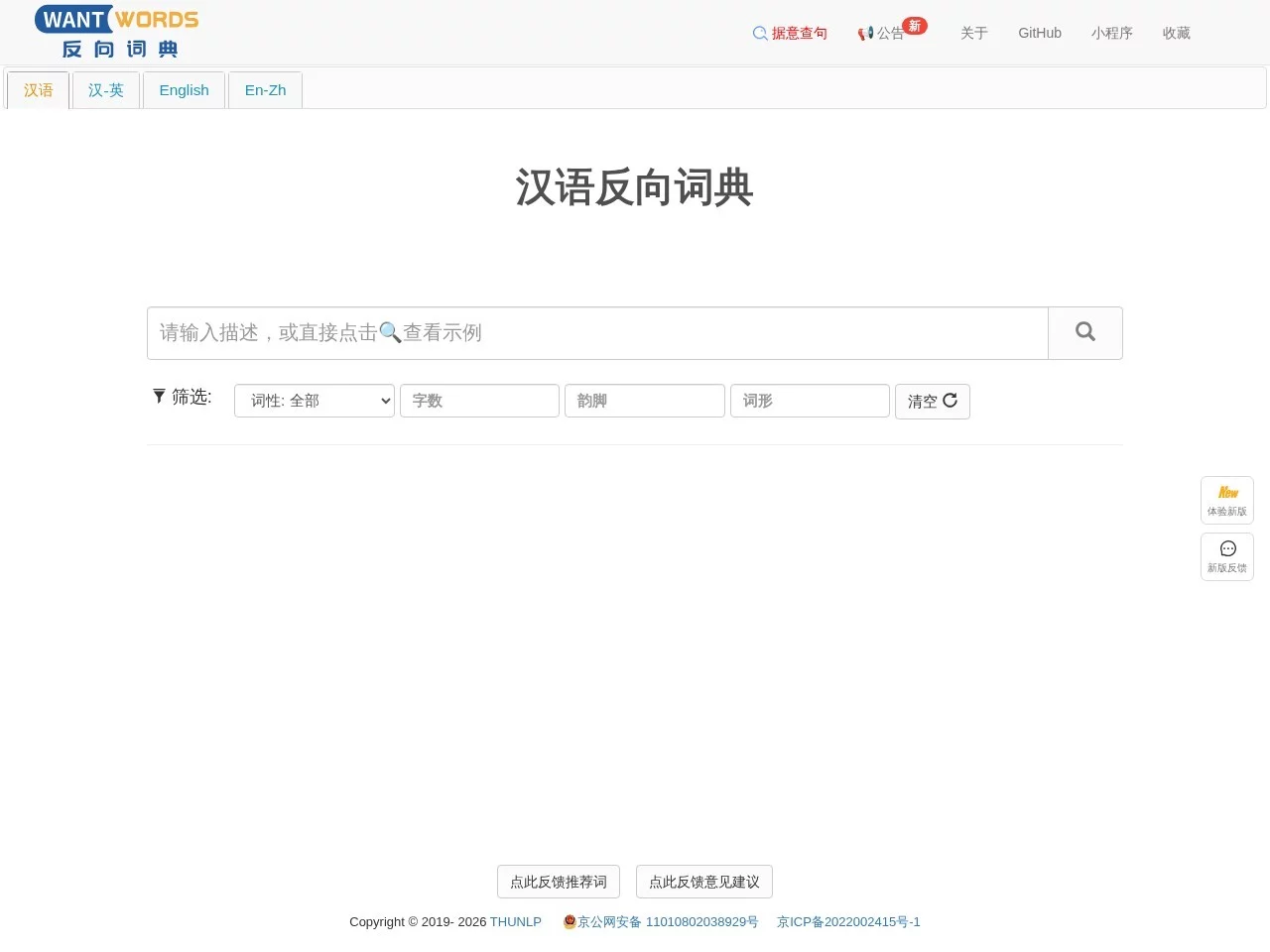
 Reverse Dictionary
 official web version
In daily writing, translation or language learning, have you ever had the trouble of “wanting to express a certain meaning but not finding the right word”? The Reverse Dictionary is a practical tool designed specifically to solve such word-related problems. It subverts the logic of traditional dictionaries that “look up meanings by words”, and instead achieves “looking up words by meaning”, allowing you to quickly match precise vocabulary expressions.
The Reverse Dictionary is an open-source online tool developed by the Tsinghua University Natural Language Processing Laboratory (THUNLP), built on deep learning algorithms. It incorporates data from multiple authoritative dictionaries and covers four query scenarios: Chinese-Chinese, Chinese-English, English-English, and English-Chinese. It provides corresponding support for both word meaning lookup in Chinese contexts and cross-language vocabulary matching.
Official website: https://wantwords.net/
The Reverse Dictionary has a wide range of applicable scenarios, meeting almost all needs for vocabulary matching:
Its operation logic is also very simple, requiring no complex settings. As long as you clearly describe the meaning you want to express in the input box, the system will automatically return a list of matching vocabulary, greatly reducing the time cost of finding words.
The matching logic of the Reverse Dictionary automatically adjusts according to the type of input content to ensure result accuracy:
Different from traditional forward dictionaries, the Reverse Dictionary completely solves the pain point of “knowing the meaning but forgetting the word”, allowing users to no longer sift through massive vocabulary one by one, but directly locate words by meaning. At the same time, its open-source nature ensures the stability and updatability of the tool, and the technical support from Tsinghua University Natural Language Processing Laboratory also continuously optimizes the matching accuracy of the algorithm.
In addition, the multilingual mode of the Reverse Dictionary covers most needs in daily and professional scenarios, whether it is writing and translation for ordinary users or vocabulary accumulation for language learners, corresponding functional support can be found.
To obtain more accurate query results, you can note the following points when using the Reverse Dictionary:
As a practical language tool, the Reverse Dictionary has become a reliable helper for many people to solve word-related troubles, playing an important role in both daily writing expression and vocabulary expansion in language learning.