
ChatGPT
ChatGPT Usage Experience and Pitfall Avoidance Tips
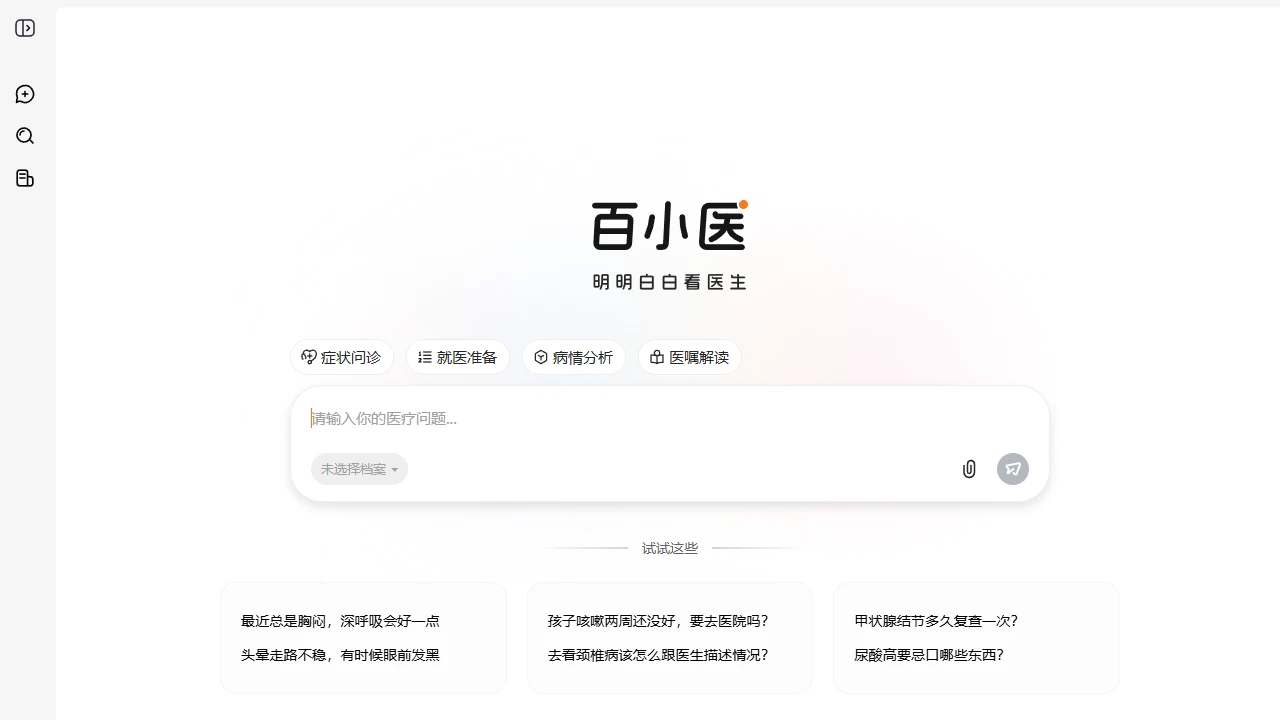
 Bai Xiao Yi
A practical AI tool focused on the Chinese-language context, capable of processing long documents
Official website: https://ying.baichuan-shturl.cc/o
When many people feel unwell, they often face a dilemma: they don’t want to queue at a hospital for a minor ailment, yet a casual online search for health problems easily turns up content of mixed reliability, making them more anxious the more they read. ying.baichuan‑shturl.cc/o is the web version of Bai Xiao Yi launched by Baichuan Intelligence. It is not a general-purpose chatbot but an AI medical assistant built specifically for health scenarios. Powered by Baichuan’s proprietary medical large language model, it runs directly in your browser — no client download or installation needed, and it works on both computers and mobile phones. It is positioned as an auxiliary tool for doctors and a health consultation helper for ordinary people. One crucial point to remember: it cannot replace the diagnosis of doctors at offline hospitals, and can only perform auxiliary tasks such as health education, symptom sorting and report interpretation.
Once you open the page, the interface is very clean, without unnecessary flashy features. At the start of a conversation, the AI introduces itself, explaining that it answers questions with reference to authoritative medical guidelines and public medical research. The page also provides many examples of common questions, such as a child’s fever, dull abdominal pain, or vaccination before pregnancy — health concerns ordinary people frequently encounter. Clicking an example starts a conversation instantly, so even users who are not good at wording their questions can get started easily. No complicated setup is required; after logging in, you can start multi-turn health conversations that fully preserve the context, so you don’t have to describe your situation again with every question.
Unlike ordinary AI that answers one question at a time, Bai Xiao Yi does not jump to conclusions as soon as you mention feeling unwell. When you describe where you feel discomfort, it follows the approach of a clinical consultation and asks for details step by step — how long it has lasted, the type of pain, whether it is accompanied by fever or vomiting, and whether you have any relevant medical history. Many ordinary people cannot grasp the key points when describing their condition, and don’t know what information to give when facing a doctor at the hospital. With its follow-up questions, scattered bodily sensations can be organised into a well-structured record of your condition. This is especially useful when you feel unwell at night and cannot see a doctor right away — you can first sort out your symptoms in full to prepare for a later visit.
Many people have had this experience: after a long queue for registration, they sit in front of the doctor with a blank mind and cannot give all the key information. Based on all the symptom information you provide, this web tool prepares two practical documents: one is a summary of your condition for the doctor, consolidating the course of illness, past medical history and allergies; the other is for yourself, specifying which department is recommended and which key questions you should actively ask during the visit. Print it out or save it on your phone and refer to it directly in the consulting room, so you don’t miss important information during the face-to-face consultation and make full use of the limited consultation time.
After seeing the doctor, you get prescriptions, lab slips and imaging reports full of professional medical terms that most ordinary people simply cannot understand. Bai Xiao Yi can help interpret medical advice, explaining clearly how to take the medicine, what dietary restrictions apply, and when to return for a follow-up; faced with a physical examination report full of up and down arrows on the indicators, it can explain in plain language what each indicator means, which ones need close attention, and which are mild fluctuations not worth excessive worry. Note that this is only popular-science interpretation and must not be used to modify the treatment plan given by the doctor; ultimately you should follow the judgement of the attending doctor.
As the examples on the page show, children’s health, pregnancy and pre-conception, and questions about everyday chronic conditions are its key coverage areas. A child’s fever at home, an adult’s stomach upset, or women’s basic questions about preparing for pregnancy and pregnancy itself can all be consulted here. If elderly family members cannot understand a medicine leaflet, you can give the content to the AI and have it converted into simple, easy-to-understand wording for the family. For frequent everyday family health questions, you can obtain fairly standard popular-science information without digging through cluttered health forums.
As a web version, its biggest advantage is zero installation cost. When a health question comes up unexpectedly and you don’t want to download an app, just open the URL in a browser; on a phone, you can also enter by tapping the link in WeChat or other social apps. Conversation history is saved under your account; if you stop halfway on a computer, you can log into the same account on your phone’s browser and continue the previous conversation without losing information. The whole page has no pop-up ads; all the focus is on the conversation itself, giving a clean and refreshing experience.
But we must be clear about the boundary: this is an AI auxiliary tool, not online medical care. Even though the medical large model has been trained on a vast body of medical literature and guidelines, model hallucinations still exist and information deviations may occur. In critical situations such as persistent high fever, severe pain, injuries or acute onset, never rely on web AI consultation — you must go to a medical institution immediately. All output content is for reference only as health education; it must never be used directly to replace a doctor’s diagnosis, and you should never buy medicine or adjust dosages on your own based on the AI’s replies.
This web tool suits several groups of people. Ordinary office workers who often cannot understand their physical examination reports; users with elderly people or children at home who need to handle small family health questions; friends who want to sort out their symptoms clearly before going to hospital for fear of forgetting things during the consultation; and people who want standard popular-science information and don’t want to be misled by fragmented health rumours online. It is also suitable for medical professionals, for quickly searching medical literature and organising reference ideas for cases.
There are also a few tips for practical use. Describe your physical condition as completely as possible — age, past medical history and drug allergies are best included — so that the AI’s answers fit your actual situation better. Don’t ask questions that demand a direct diagnosis such as “What illness do I have?”; instead treat it more as an assistant for organising information and answering health questions. After receiving the AI’s output, if it involves medication or disease judgement, be sure to confirm with an offline doctor again. Do not casually enter highly private information such as your ID number or full name into the dialogue box; just describe the symptoms to protect your personal privacy.
Overall, the Bai Xiao Yi web version is a good health auxiliary tool that fills the gap in ordinary people’s understanding of information before and after seeing a doctor. For many people, falling ill does not immediately mean a serious disease; rather, they have a pile of health doubts they cannot understand or figure out, and this web tool is suited to handling such scenarios. Bookmark the URL in your browser, and open it to sort out information and look up health knowledge when family health doubts arise. But always keep firmly in mind that real disease diagnosis and treatment should still be left to professional doctors at regular offline hospitals.