
WiFi Connection Card
Online creation of QR codes for WiFi scanning links, one-click WiFi connection QR codes
 PayQrcode
Free and open-source online tool to merge WeChat and Alipay payment QR codes, the latest physical merging combines WeChat and Alipay payment QR codes into a unified QR co...
What’s the biggest fear when collecting payments at a stall? Customers take out their phones and first ask, “Boss, is this WeChat or Alipay?” Two payment QR codes are placed side by side on the counter, and embarrassing situations like scanning the wrong code, scanning slowly, or switching between apps repeatedly happen almost every day. PayQrcode is a payment QR code merging tool built specifically to solve this pain point. Its core function is “physical merging of two payment QR codes” — directly combining two payment QR code images into one, allowing customers to complete payment with a single scan, making the in-person payment experience much smoother.
Official website: https://pay-qrcode.4ce.cn/
Uncle Zhang, a breakfast stall owner, waits at the soy milk stall at the alley entrance at 6 a.m. every day. Some time ago, to accept payments via both WeChat and Alipay, he printed two A4-sized payment QR codes and stuck them in a prominent place on the glass counter. But trouble soon came knocking: once an aunt carrying a vegetable basket came to scan, her eyesight was not good so she couldn’t see clearly, scanned the Alipay code, and realized after payment that she needed to send money via WeChat, so she turned around to ask Uncle Zhang to change it; during peak hours, a student in a hurry was still switching between apps after scanning for a long time, and a small queue formed behind, making Uncle Zhang sweat profusely. For small businesses like Uncle Zhang, the simpler the payment method, the better. Putting two codes side by side is not only messy, but also leads to customers scanning the wrong code in poor light, elderly customers not being familiar with switching between apps, and inefficient scanning during peak hours — all real small troubles affecting business. Combining two payment QR codes into one means completely removing the “choice cost” from customers.
There are many payment QR code merging solutions on the market, but most belong to the “dynamic redirect” type: after a customer scans the code, they first access a relay server, which then judges and redirects to the corresponding platform. The biggest risk of this type of solution is its heavy reliance on servers — once the relay service is shut down, rate-limited, or malfunctions, the posted code becomes useless, and all the pre-printed materials are wasted. PayQrcode took a different approach, avoiding these problems at their root.
Physical merging refers to directly combining two QR codes into a new QR code image at the image level, with no reliance on any server throughout the process. The merged code does not go through a third-party relay, fundamentally avoiding the usage risks caused by server downtime or service suspension. The code is local and independent, it can be used for as long as it is posted, without worrying about it becoming invalid halfway.
A more critical point is information integrity. PayQrcode runs entirely offline, and does not make any changes to the original information during QR code parsing and merging. The key data related to payment is retained as it is, ensuring integrity and accuracy, so customers will not find that the payment account is incorrect after scanning.
For small businesses, losing internet connection is common. Breakfast stalls in alleys, handmade shops at night markets have unstable signals. If a dynamic redirect payment QR code is used, once the internet is cut off, payments cannot be collected, which is like losing half of the business line. But PayQrcode eliminates this worry — its merging process is completed entirely locally. No matter how the surrounding network is, the printed payment QR code works normally, even after half a year, customers can still be redirected to the correct payment platform after scanning.
Earlier, Sister Chen who runs a fruit shop tried that dynamic redirect payment QR code. As a result, in less than a month, the relay service malfunctioned, and all over twenty payment QR codes she printed became useless. She had to find a new place to reprint them, delaying business for several days. Later, she switched to PayQrcode’s merged code, and never had to worry about such things again. Even when setting up a stall next to a basement warehouse with poor signal, payments went smoothly, and she didn’t have to explain to customers: “Wait a minute, this code I scanned might take a while.”
In fact, it’s not that complicated. Any offline small business that needs to accept payments via both WeChat and Alipay can use this tool. Whether it’s a breakfast stall, convenience store, fruit shop, handmade vendor at a night market, or a shoe repairman at the entrance of a residential area, as long as they can open a webpage on a computer or mobile phone, they can operate it.
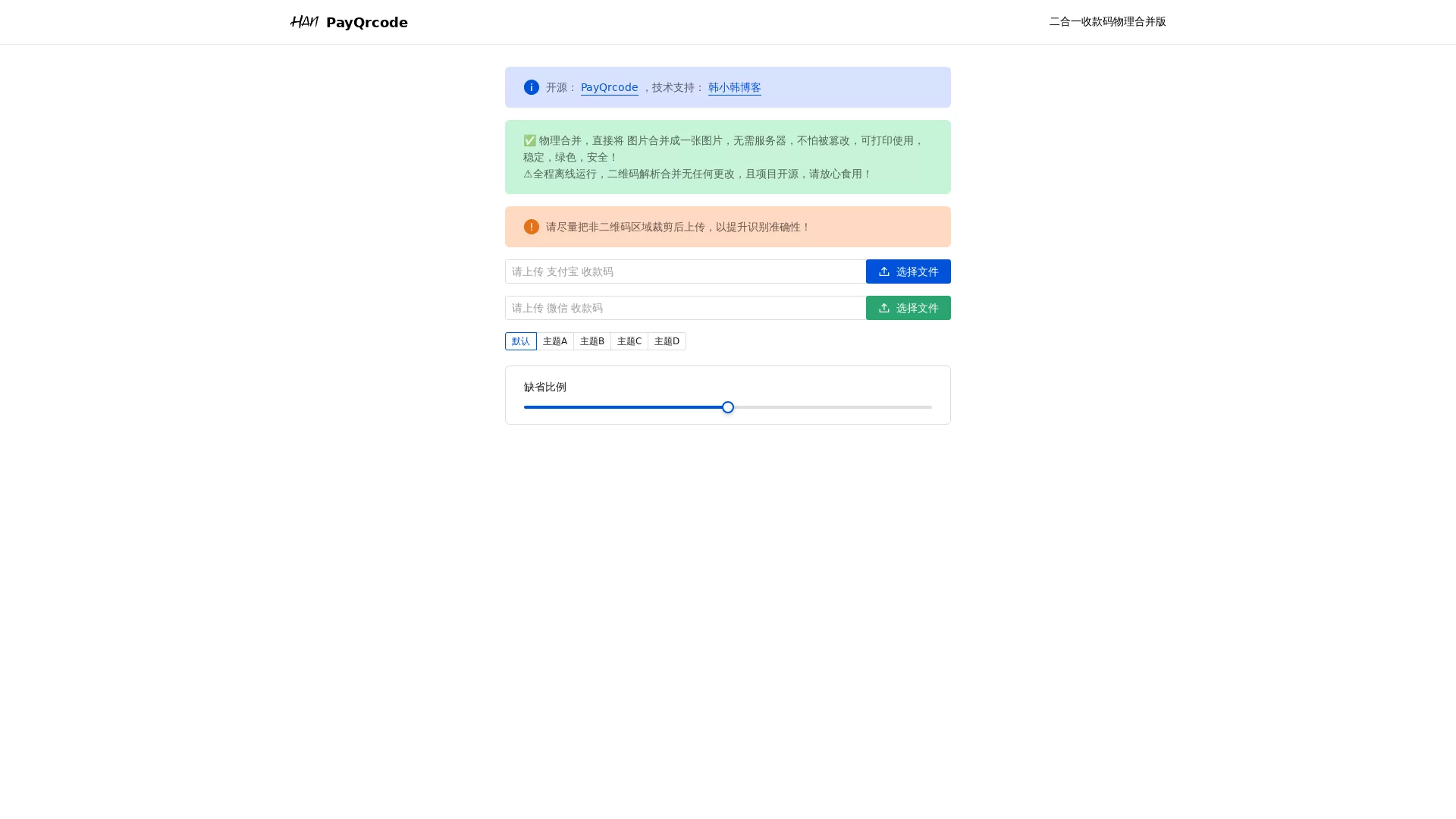
The operation is also simple, no complex technical knowledge is needed. Just open the official page, upload the WeChat and Alipay payment QR code images respectively, click merge, and you will get a new payment QR code image. Take it to a print shop to make small stickers or posters, and stick it on the stall. No extra cost, no software to download, saving a lot of trouble. For small businesses that don’t have much experience with online tools, it’s easy to get started.
That said, not all merged codes need to choose physical merging. If the payment service you usually use is stable, a dynamic redirect solution can also work. But for small businesses that hate trouble and don’t want to take risks, PayQrcode’s physical merging is indeed more reliable. At least you don’t have to worry that one day the service will stop, and your payment QR code will become useless.