
east.im
AI tool platform
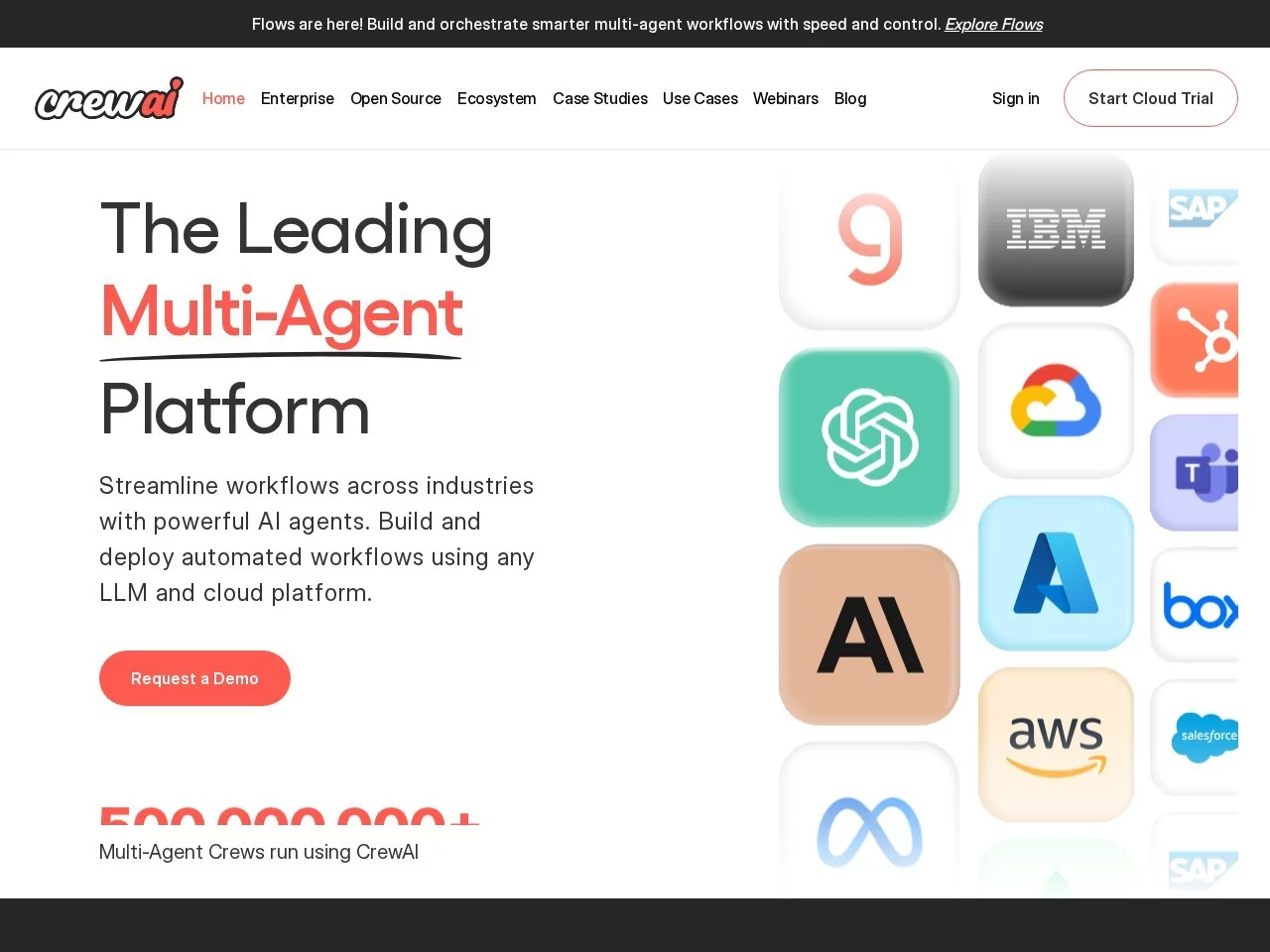
 CrewAI
Multi-agent collaboration framework designed to enable AI agents to work together seamlessly to solve complex tasks by fostering collaborative intelligence
Imagine you have a job to do: first, you need to collect industry data, then organize it into a report, and also follow up on subsequent user inquiries. Letting a large model do everything from start to finish often leads to inefficiencies and gaps. CrewAI offers a solution—don’t let one AI work alone, build an AI team. It is a multi-agent framework focused on collaborative intelligence, allowing multiple AI agents with different expertise to cooperate and complete complex tasks together.
Official website: https://www.crewai.com
In other words, CrewAI’s core focus has never been “how powerful a single model is”, but how a group of models with different strengths can work together as a cohesive unit. This approach is also the most essential difference between it and common single-model applications.
CrewAI manages AI agents like real team members. You can assign clear responsibilities to each agent, such as letting it act as a researcher responsible for verifying information, arranging a writer responsible for outputting drafts, or letting a customer service supporter handle user inquiries. Different roles lead to completely different behavioral logics and output focuses for agents.
These agents can not only execute tasks autonomously, but also take the initiative to communicate and connect with other agents when needed in the process. You don’t need to manually “pass messages” at every step; the framework itself drives the collaboration chain to operate automatically, significantly improving overall efficiency.
Being role-based doesn’t mean being rigid. By customizing goals and tools, you can make the same “role” show completely different working methods in different business scenarios—it can run standardized processes and also accommodate customized requirements.
浓缩 CrewAI 的能力成一张清单,大致是这些:
特别说一下动态分配的价值。传统脚本习惯把流程写死,一旦需求变动就要大改;而 CrewAI 允许任务在运行中被交给当下最合适的代理去处理,系统面对变化更有弹性。这也让它“无需复杂编程即可快速部署多智能体系统”的目标真正成立。
It is perfect for building a comprehensive intelligent assistant platform—incorporate agents with different functions such as information retrieval and content generation into the same pipeline, tapping into customization potential, and delivering a complete assistant covering multiple links.
You can build an automated customer service team: the front desk is handled by customer service agents, and the back desk is completed by other agents for supporting processing, thus running an end-to-end service chain and freeing human resources from repetitive responses.
Simulate a real multi-agent research team: researcher agents are responsible for collecting and organizing materials, writer agents are responsible for writing articles, and the cooperation of these two roles can improve both efficiency and quality of output.
Whether you are a technical developer, researcher or enterprise decision-maker, you can find a matching entry point in CrewAI.
Can it be used with zero foundation? Yes. No-code tools and templates are designed for non-technical personnel, and ordinary business personnel can also build applications independently.
Is it tied to a single model? No. It supports integration of multiple language models, including Ollama and LlamaIndex, which can be switched freely according to project needs.
Who to turn to when stuck? Official documents and tutorials cover basic usage, and the community is the main position for solving problems, where most practical questions can get responses.
From role division, autonomous collaboration, to dynamic scheduling and ready-to-use templates, CrewAI has pushed “multi-agent collaboration” from conceptual demonstrations to daily productivity. When you first see several AI agents working together to smoothly advance a complex task, you may re-evaluate: many jobs that used to require a lot of human time actually have another solution.