YiziPaper
AI Writing Assistant
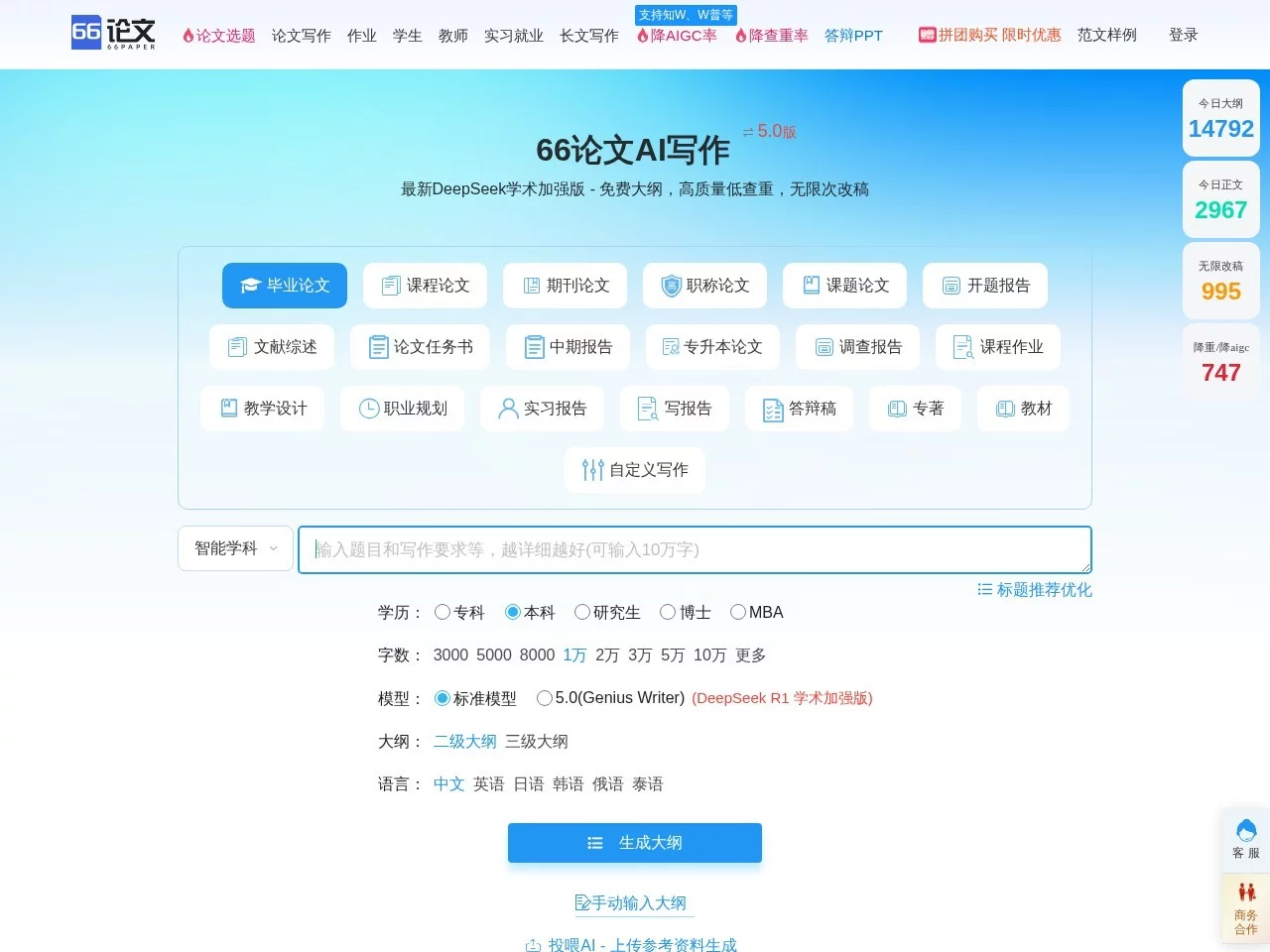
 66论文
High-quality paper writing, an AI writing platform used by 3 million college students.
The most frustrating part of writing a paper is never the wording of a single sentence, but the bottlenecks in the entire process from topic selection to plagiarism check: no direction for the topic, inability to build an outline, no clue about the first draft even after staying up until dawn, and fear of violating plagiarism rules during the check. Many AI tools people have tried can only piece together a few scattered sentences, or require users to supplement most of the content themselves, failing to solve practical problems. 66 Paper is designed to address this pain point.
Official website: https://www.lunwen66.com/
Compared to ordinary internship reports, graduation theses have completely different requirements: the former must comply with academic standards and have solid argumentative logic; the latter is more practical, focusing on clarifying internship content. The core advantage of 66 Paper is that it integrates writing processes for these different needs. Whether it is a graduation thesis, a professional title paper, or an ordinary internship report, users can find corresponding support on this platform, eliminating the need to switch between multiple tools repeatedly.
Different from AI tools on the market that only provide scattered content, 66 Paper truly intervenes in the entire writing process. When you haven’t sorted out your ideas, you don’t have to force yourself to draft an outline; you can directly let the platform generate one. Moreover, this outline is free and unlimited in number — if you are not satisfied, you can replace it with another version until the structure looks good. What’s more considerate is that the generated outline can be adjusted by yourself; you can modify the order of chapters and the level of detail, so you won’t be stuck in a fixed framework.
After the outline is finalized, the speed of completing the paper is the most obvious difference. If you write a first draft of tens of thousands of words by yourself, you may have to stay up several nights. 66 Paper can produce a tens-of-thousands-word first draft in only about 3 minutes, compressing the work that originally took several days into the time of a cup of coffee. However, this doesn’t mean you can use it directly. The first draft from the platform provides a skeleton; you still need to supplement details and adjust arguments, but it solves the most time-consuming parts of framework building and basic content filling.
After finishing the first draft, the most headache-inducing part is the plagiarism check. If you use different plagiarism check tools by yourself, it will not only cost a lot of money, but also worry about inconsistent results. The plagiarism check function in 66 Paper is integrated with the previous writing process. You don’t need to export files and switch platforms; you can check directly within the platform, which helps avoid problems of exceeding the plagiarism rate limit. However, you still need to verify the plagiarism check results yourself, because the core of academic standards is still your original content.
Some people may ask, with so many AI tools on the market, what is the difference between 66 Paper and them? Take the outline as an example: many tools generate identical outlines, such as all liberal arts papers having “introduction, main body, conclusion” regardless of the characteristics of specific fields. But the outline of 66 Paper will be adjusted according to the specific writing type. For example, graduation theses will add academic essential modules like “literature review, research methods”, while internship reports will focus on practical parts like “internship content, summary of gains”, so it won’t give people a template-like feeling.
As for speed, some AI tools only generate content after reaching a certain word count, and require repeated parameter adjustments in between, wasting a lot of time. But 66 Paper’s first draft directly generates a complete content framework, so you don’t need to piece it together manually. The efficiency of producing a draft in 3 minutes is really a big help for people rushing to meet deadlines. However, it should be noted that the first draft is only a foundation and cannot be directly submitted as the final paper; you need to sort out the logic yourself.
In addition, the plagiarism check function of many AI tools is paid separately, and the price is not low, which is a considerable burden for students. But 66 Paper’s plagiarism check is integrated into the entire process service, so you don’t need to pay extra. This is indeed a worry-free choice for people with limited budgets. Of course, its plagiarism check results are only for reference; the final result should be based on the plagiarism platform recognized by the school or institution, since the databases of different platforms are different.
Although 66 Paper can save a lot of effort, it can’t be used directly. For example, after generating the outline, it is best to review it yourself first. If the content of a certain chapter doesn’t match your topic direction, adjust it in time; don’t wait until writing the first draft to modify it, otherwise it will waste time. Also, the content in the first draft, especially the cited parts, must be verified by yourself. Don’t take others’ ideas as your own, otherwise it will easily cause problems during the plagiarism check.
In addition, if you are writing a paper in a niche field, such as academic reports for certain majors, the generated result of 66 Paper may not be very accurate. At this time, you can first communicate with the platform’s customer service, explain your specific needs, and adjust the generation direction, which will be much better than using the default settings directly. After all, it is just an auxiliary tool; the core still lies in your own thinking and original content.