YouCompress
Free online compression for videos, images, audio and PDF files
 miniPaint
 is an online image editor developed based on HTML5 technology, known as an open-source alternative to Photoshop. Users can run miniPaint directly in their brows...
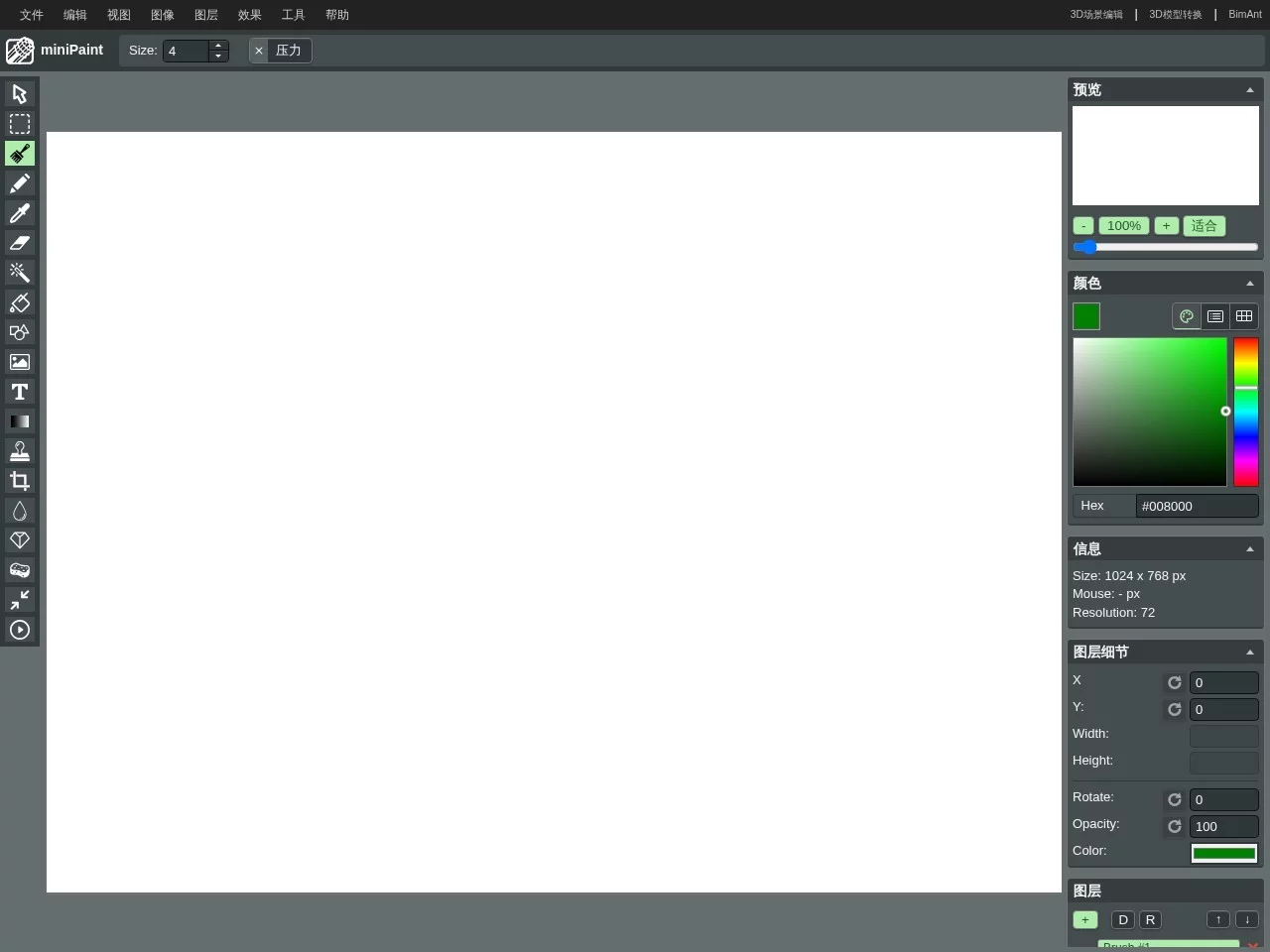
Want to edit, cut out, and add filters to images directly in your browser without downloading professional software that takes up several GB? miniPaint is the tool built for such needs. It is an online image editor developed based on HTML5 technology, usable by simply opening a web page—no download or installation required. Users often call it an open-source alternative to Photoshop. From daily photo retouching to multi-layer compositing, it provides a lightweight yet professional solution.
Official website: http://ps.bimant.com/
The installation process of traditional image software often discourages many casual users: downloading the installer, registering an account, taking up disk space, and ending up using only a tenth of its features. miniPaint completely simplifies this process—it runs directly in the browser. Whether you use Chrome, Firefox, Opera, Edge, or Safari, opening the link takes you to the editing interface, no different from operating a regular web page.
What’s more valuable is that its functional depth is not compromised by being “online”. It has a complete set of features including multi-layer system, filter effects, selection tools, and text layout. Its interface layout is also close to mainstream desktop image editing software, so users who have used Photoshop hardly need any learning cost and can start working immediately.
Layers are the watershed to judge whether an image editor is “professional”. miniPaint supports a multi-layer editing system, allowing you to place backgrounds, subjects, text, and decorative elements on separate layers for independent adjustment without interfering with each other. When making posters, covers, or complex composites, this working method is exactly the same as desktop-level software.
The richness of the tool library directly determines the freedom of creation. miniPaint has over 40 effect filters built-in, so common processing needs can basically be done in one stop:
The smoothness of image import and export channels often affects the user experience more than the functions themselves. miniPaint supports multiple ways to load images: you can directly drag and drop to upload, or open local files from the menu. After editing, you can also export to various formats such as PNG, JPG, BMP, seamlessly connecting to subsequent publishing or archiving processes.
If you are used to deploying tools in your own environment, it also provides a Docker deployment solution that can run on a local server, suitable for teams with intranet usage needs.
Many people worry that online tools will upload images to servers, causing privacy leaks. miniPaint’s design in this regard is quite reliable: all editing operations are completed in the local browser, and image data will not be sent to any server. Even if you are processing screenshots or ID photos containing sensitive information, you don’t have to worry about data leakage.
Its cross-platform performance is also excellent:
No. You can use it directly by opening the web page—no account system, login process, or subscription fees.
Since all calculations are done locally in the browser, once the page is loaded, the editing process itself does not depend on real-time server responses. However, to ensure a stable experience, it is recommended to keep the network connected for normal page loading.
Professional desktop software still has advantages in handling very large files, some advanced color grading, and print-level output. But for high-frequency needs like daily image editing, layer compositing, and filter processing, miniPaint’s performance is already excellent. Plus, it requires no installation, is zero-cost, and cross-platform, making the overall experience very cost-effective.
Chinese users can access the web version through the Chinese official website entry ps.bimant.com, or visit the project official page viliusle.github.io/miniPaint. Both have the same functions—choose as per your habit.
For people who edit images occasionally, it is a lightweight toolbox that is ready to use anytime. For developers and teams pursuing controllability, it is an open-source solution that can be self-deployed and redeveloped. Next time you need to process an image quickly, just enter its URL in your browser and experience the smoothness of “open and use”.