Screenshots
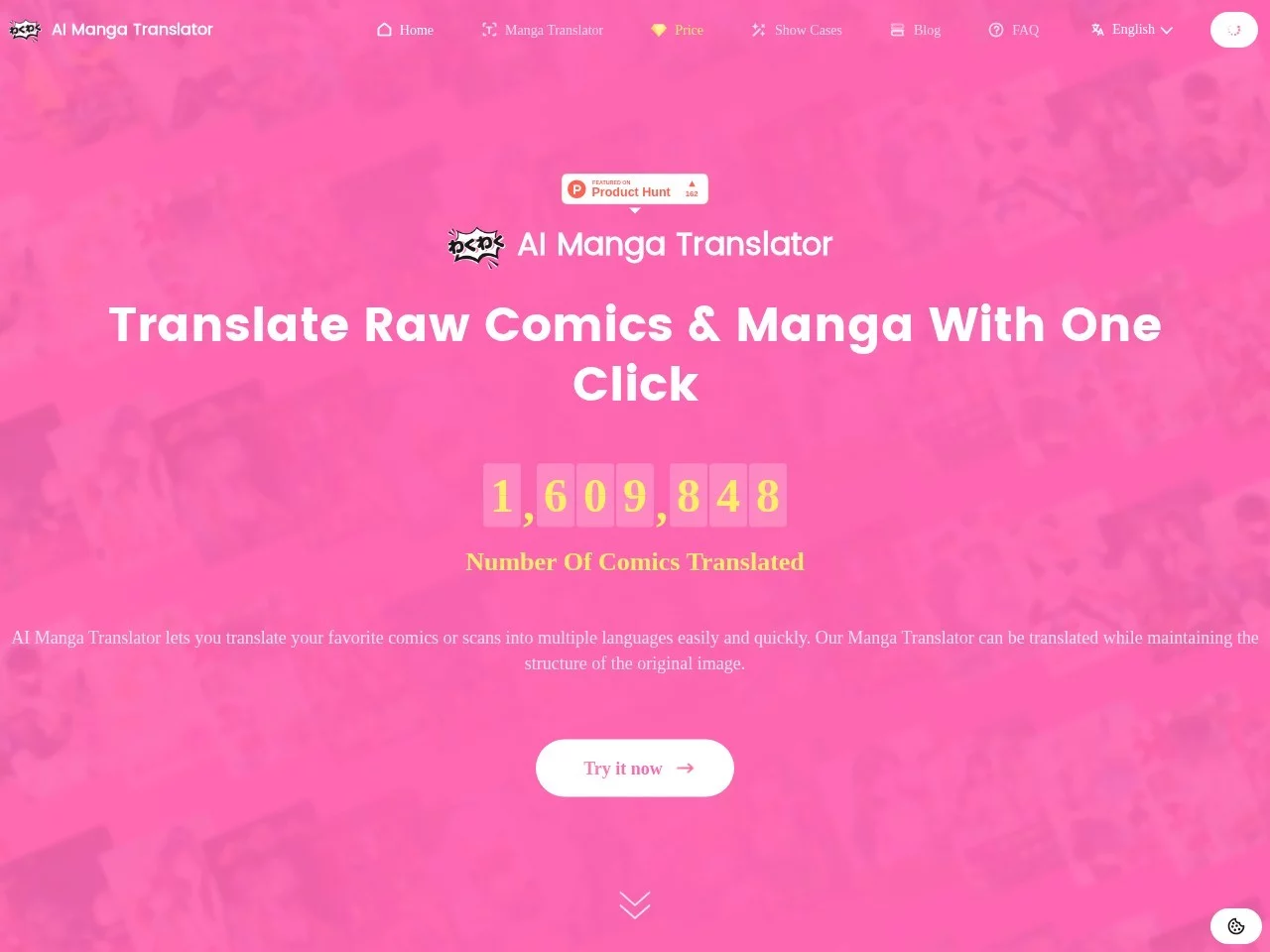
If you’re a manga fan who’s collected a hard drive full of raw manga, you’ve definitely had this frustrating experience: finally getting your hands on a popular ongoing series that hasn’t been localised into Chinese, only to get stuck on the dialogue, guessing the plot from machine translation results, and worrying about missing the subtle nuances of the original work. AI Manga Translator is designed to solve exactly these problems — you don’t have to struggle through raw manga with a dictionary, or guess the plot from blurry machine translation results.
How to quickly understand the original lines when stuck on raw manga?
I tried using it to translate a newly updated short Japanese raw manga last week, and the whole process went much smoother than I expected. No extra plugins needed — just open the webpage to use it. First, find the official website entrance: https://aimangatranslator.com/zh-CN/. You just need to drag a single page or the entire image of the manga into the upload box, select the language you want to translate to, click a button and wait for the result. The most reassuring thing is that it won’t distort the manga’s images — the original screen tones and speech bubble shapes are all preserved, and the translated text fits exactly in the original positions, not conflicting with the original layout at all. It looks just like a localised version of the manga.
Don’t think it’s just simple text conversion — it can recognise two types of text in manga: printed text and handwritten text. For handwritten lines in some doujinshi or old manga, which other tools often misinterpret, it can capture them accurately. If you’re translating a multi-panel manga, you don’t need to process each panel individually — you can upload the whole batch, and it will automatically arrange the translation results in order later, so you don’t have to organise them manually.
Why does it balance translation accuracy and image integrity?
This is thanks to the technology it uses: it combines AI and OCR capabilities. It first accurately extracts the text from the manga, then translates it into the target language using the corresponding translation model. It supports many models, including commonly used ones like Google Translate and DeepL, as well as several open-source models. You can choose according to your needs — whether you want a translation closer to the original tone or want to save costs, you can find a suitable option.
Unlike other tools, it won’t mess up the manga’s image structure just to fit the translated text. Even for complex speech bubbles with screen tone backgrounds, it can fill the translated text exactly without blocking the original details. I’ve had issues with other tools before, where translated text would cover a character’s face or background, but this tool never does that. The translated images look as natural as the original, with no sense of incongruity.
Who else can it help besides individual manga readers?
If you work in manga translation or create content for platforms, this tool can significantly improve your efficiency. It supports multilingual translation, not just Chinese-Japanese-Korean, but also English, French and others. You can use it to get a rough translation of the raw content first, then fine-tune the details yourself, saving half the time compared to translating from scratch. Some online manga platforms also use similar functions to provide instant translations for users, so they don’t have to wait for official localisations, making their reading experience smoother.
Other content creators, such as those making doujinshi or wanting to reference foreign manga styles, can use it to quickly understand the original dialogue logic without guessing the plot from raw manga. Language learners can also use it — translated manga lets you enjoy the visuals while learning a foreign language by comparing the translation, which is much more interesting than just reading textbooks.
What different experiences do different users get from it?
Regular users don’t need any prior experience — it works on both the web and Chrome extension, so you can use it on a computer or tablet, just open it and go. Also, it has no ads, so no pop-ups mid-translation to interrupt your manga reading. There’s no need to worry about privacy either — it won’t use the manga you upload or the translation content, and won’t leak your preferences.
If you use it frequently, there are both free and paid modes. The free version has a fixed number of translations per month, enough for occasional manga reading. The paid version has more translations and unlocks advanced features, such as batch processing entire volumes of manga or using more translation models, suitable for frequent users. I currently use the free version — the monthly limit is enough to translate two or three short series. Occasionally, if I want to translate a long series, I’ll subscribe to the monthly plan, which is much more hassle-free than waiting for updates from localisation teams.