Screenshots
Why do more and more researchers entrust their literature work to Elicit
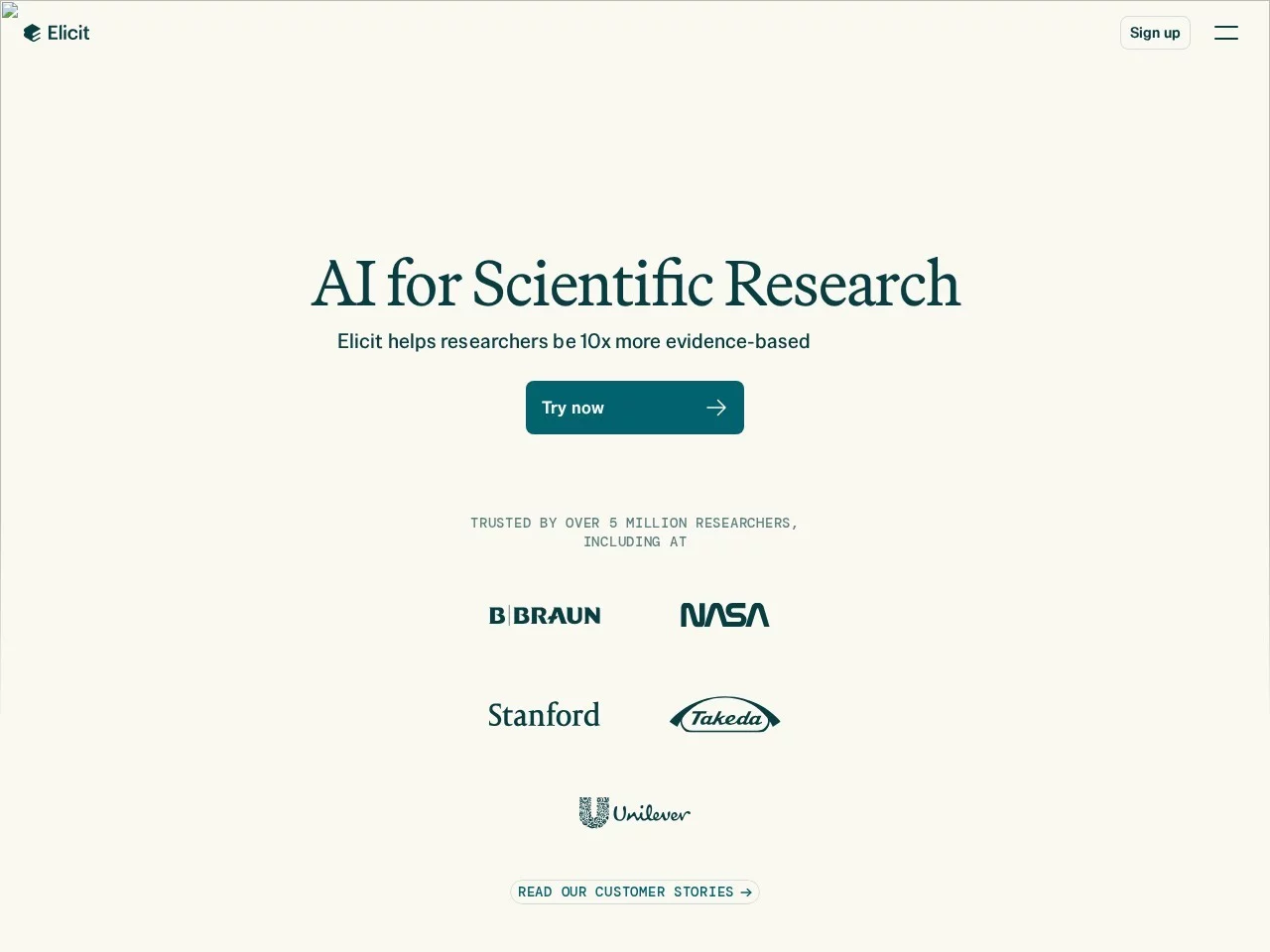
The most time-consuming part of writing a paper is often not starting to write, but the preparation before that: searching databases, reading abstracts one by one, manually organising data tables, and repeatedly confirming whether the research methods are reliable. If these processes can be handled by AI, research efficiency will make a qualitative leap. Elicit is exactly such an academic research assistant built on artificial intelligence technology. It leverages advanced Natural Language Processing (NLP) and Large Language Models (LLM, e.g., GPT-3) to automate the entire research chain from literature retrieval to data extraction and topic discovery, allowing researchers to focus on the parts that truly require thinking.
Official website: https://elicit.com/
Different from traditional keyword search engines, Elicit understands “research questions” rather than isolated keywords. Even if your wording is not precise, it can identify papers related to your research topic, which is particularly useful in interdisciplinary retrieval or when first entering a new field. In addition to finding literature, it can also be used to filter research types, automate research processes, brainstorm, and summarise content, covering multiple stages of empirical research.
Breakdown of Elicit’s Core Capabilities
Elicit’s functional design always revolves around the three words “save time”. The following are the most frequently used capabilities:
- Intelligent Literature Search: Directly raise your research question, and the system will return relevant papers. Even if the keyword matching is not complete, it can accurately identify literature related to the topic.
- Automatic Abstract Generation: Extract a core abstract of one or two sentences for each paper, and extract key information. You can judge whether a literature is worth reading in depth within a few minutes.
- Data Extraction and Analysis: Extract data from selected papers and automatically organise it into a table. You don’t need to copy and paste manually for subsequent analysis.
- Topic Discovery and Comprehensive Analysis: Identify common themes and concepts in research across papers, helping to discover new research directions.
- Personalised Recommendations: Combine your interests and historical reading records to continuously push relevant literature, so you won’t miss new developments in the field.
These five capabilities together exactly correspond to the complete path of a literature review: finding literature — reading literature — extracting data — identifying patterns — supplementing new knowledge. For researchers who have to process dozens of papers every day, the time saved is considerable.
Real-World Use Cases: How Much Effort Does It Actually Save
Quickly Understand an Unfamiliar Field
Suppose you have just taken over an interdisciplinary project in machine learning and know nothing about the mainstream methods and controversial points in the field. Submit your research question to Elicit, and it will first retrieve highly relevant papers, then help you quickly screen with a one-sentence abstract: which ones focus on methods, which on experiments, and which are just reviews — all clear at a glance. Then, with the topic discovery function, after several rounds of analysis, the research context of this field will take shape roughly.
Batch Organising Experimental Data
When conducting a systematic review, you often need to extract information such as sample size, experimental design, and outcome measures from dozens of papers. Elicit’s data extraction function can automatically organise these contents into a structured table. You only need to check and supplement, instead of going through each original paper one by one. The work that originally takes several days can often be compressed to half a day.
For researchers in empirical research fields such as biomedicine and machine learning, the efficiency improvement brought by Elicit is particularly significant.
Frequently Asked Questions
Is the Free Version Enough?
Elicit offers two versions: free and paid. The free version is suitable for personal use and is enough to experience the main functions such as literature search and abstract generation. The paid version provides higher data extraction limits and priority customer support, making it suitable for research teams with large batch processing needs. It is recommended to first use the free version to run through the process, then upgrade as needed.
Will It Replace Manual Reading?
No. Elicit is positioned as an “assistant” rather than a “replacement”: it is responsible for quick location, initial screening, and organisation. The final critical judgement and methodological review still need to be completed by the researcher. Treat it as an accelerator, not a replacement, to maximise its value.
Which Fields and Devices Are Supported?
It has the most prominent support for empirical research fields such as biomedicine and machine learning, while also meeting the research needs of other fields. As an online tool, Elicit supports multiple language models and mainstream browser environments. You can use it directly after registering an account without complex configuration.
Getting Started Tips: Three Steps to Begin Using
- Register an Account: Visit the official website, register and log in using your email;
- Submit Your Research Question: Input your research topic with a natural description, rather than piling up scattered keywords;
- Filter and Extract: Check the relevant papers, let the system generate abstracts and data tables, then export them for in-depth analysis.
When you first start using it, you may as well practice with a small topic: for example, ask it to sort out representative literature on a certain concept within ten minutes, then verify the results manually. After a few attempts, you will master the skills of asking questions, and gradually distinguish which tasks are worth handing over to AI and which must be handled personally. When a literature review changes from “drudgery” to efficient conversations, you will have more time for real thinking and writing.