
橙篇
主要功能包括专业知识检索与问答、超长图文理解与生成、深度Edit和跨模态自由创作
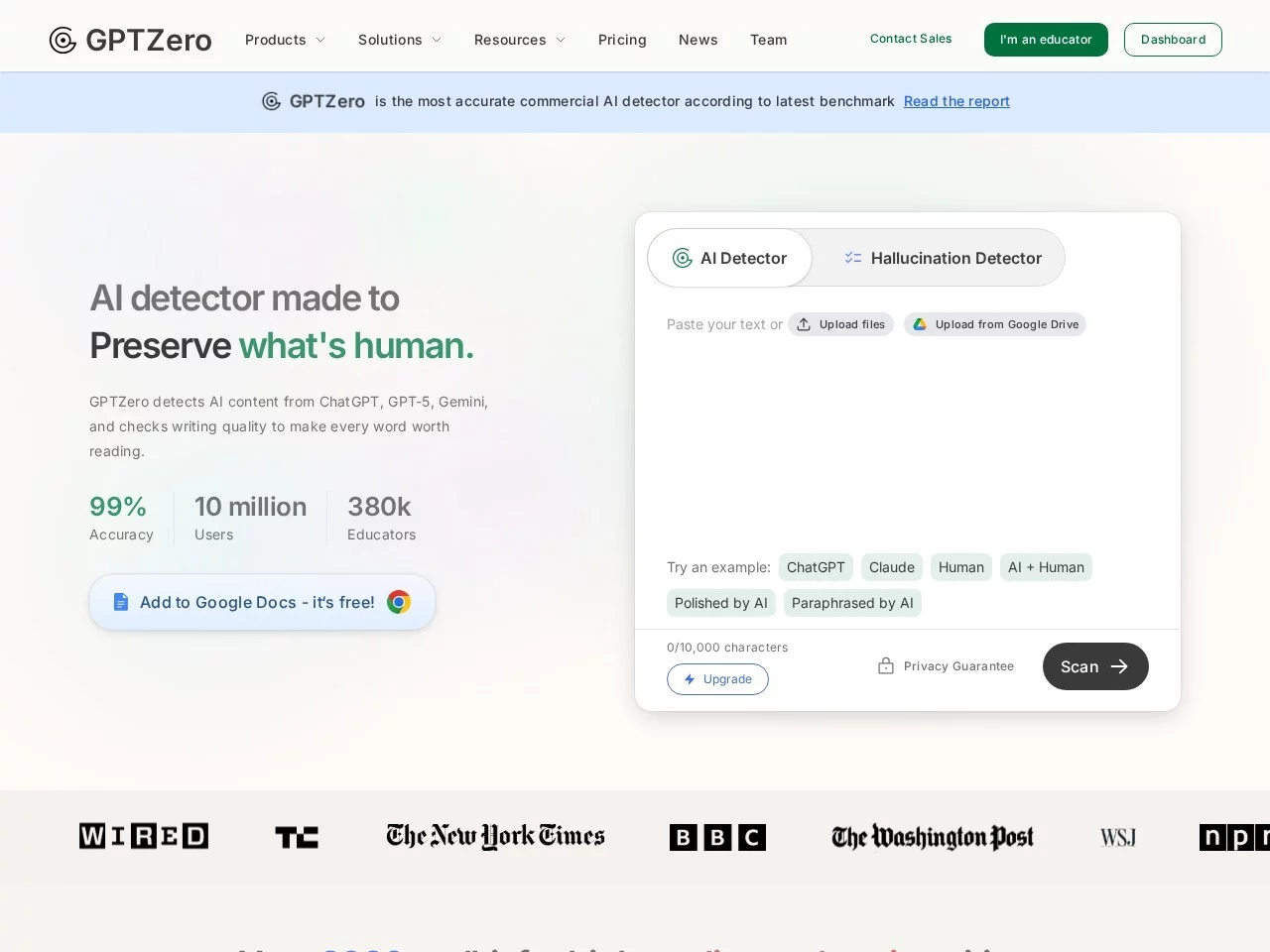
 GPTZero
AI content detection tool designed to distinguish whether text is written by humans or generated by artificial intelligence
As large language models like ChatGPT and GPT-4 become part of daily writing, the question of whether a piece of text is human-written original or machine-generated has become an unavoidable issue in many scenarios. GPTZero is an AI content detection tool designed to answer this question, developed by Princeton University student Edward Tian, which identifies the true source of text based on deep learning algorithms and statistical features.
Official website: https://gptzero.me/
This tool has a very clear design purpose: to help users address issues such as academic misconduct and fake news dissemination, and provide judgment support in fields like education, recruitment, and publishing. When teachers suspect assignments are written by ChatGPT, editors face submissions of unknown origin, or recruiters review documents submitted by candidates, they can use GPTZero to obtain an analytical result with reference value.
GPTZero has a very low usage threshold; the entire process can be summarized into three steps, and ordinary users can get started without any technical background.
One of the most distinctive metrics in the report is the burstiness score. Simply put, it reflects the generation pattern of the text: human writing often has a mix of long and short sentences with obvious rhythm fluctuations, while AI-generated text is relatively smooth and uniform. Through this metric, users can gain a more detailed understanding of the possible creation methods behind the text.
The detection result is more like a “reference opinion” rather than a final judgment. It is recommended to read the report in combination with the context and your own judgment.
Based on actual needs, GPTZero has a wide range of applicable users; anyone who needs to distinguish the source of text can use it as an auxiliary tool. Common scenarios include:
For these types of users, the value of GPTZero is not to make conclusions for others, but to provide a verifiable clue: after the report points out which paragraphs are suspected of being AI-generated, users can conduct targeted manual communication and confirmation, greatly improving the review efficiency.
No AI detection tool is omnipotent, and GPTZero is no exception. Existing studies have pointed out that it has misjudgment issues in some cases, such as incorrectly identifying some human-written original text as AI-generated. Once this “collateral damage” occurs in academic review or content review scenarios, it may cause unnecessary disputes.
In addition, some studies also show that GPTZero performs worse than other detection tools in some fields. That is, different tools are good at different types of text, and it is not advisable to rely solely on the result of one detection.
It mainly targets text generated by large language models like ChatGPT and GPT-4 for identification, and has good coverage of content produced by mainstream AI writing.
No. The report only indicates that the relevant text has the characteristics of AI writing; misjudgments exist objectively, and the final conclusion still needs to be combined with manual review and other evidence.
In the current era where AI writing is becoming more and more common, learning to use tools like GPTZero to distinguish the source of text has become a required course in fields such as education, publishing, and recruitment. Understanding its working logic, making good use of its reports, and clearly recognizing its limitations are necessary to truly let technology serve content review.