Real-time Exchange Rate Network
Real-time exchange rate query and real-time exchange rate converter, such as real-time USD to CNY exchange rate
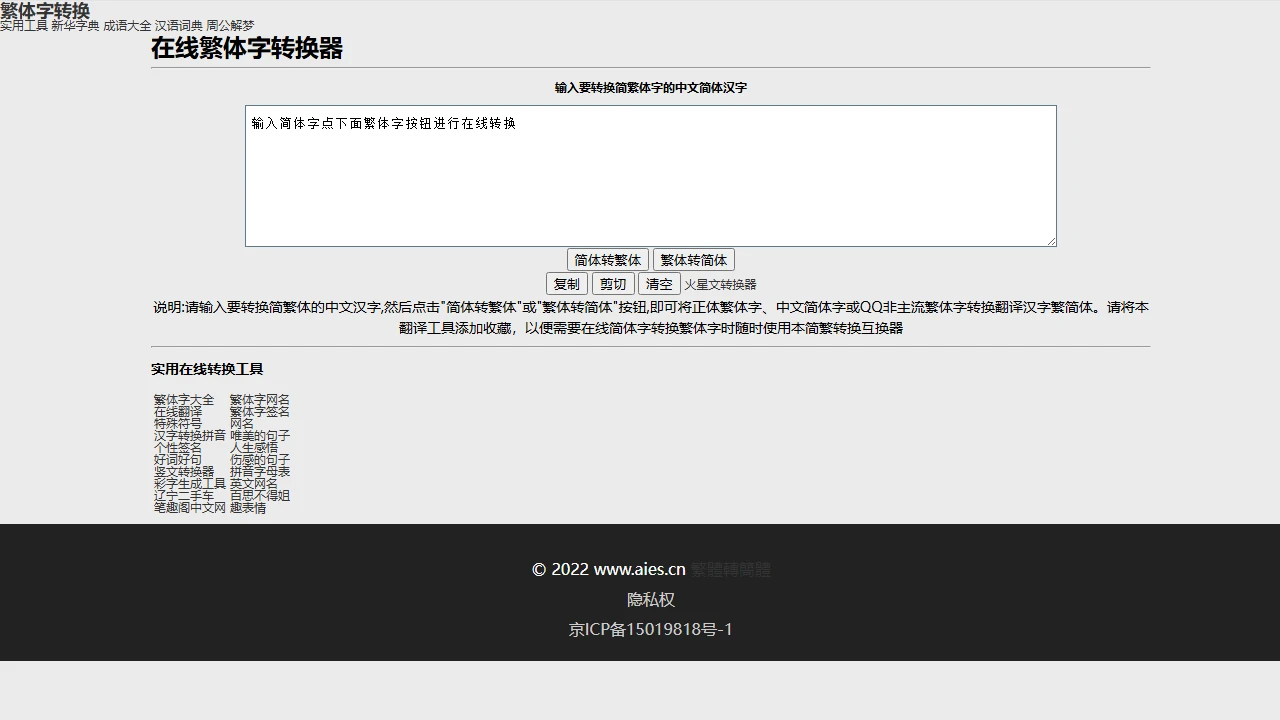
 Simplified-Traditional Chinese Conversion
Simplified-Traditional Chinese Character Conversion
Many people have fallen into pitfalls when using Simplified-Traditional Chinese conversion tools — even if the text is converted to Traditional Chinese, it may be bounced back by a Taiwanese client’s email due to incorrect wording, or the converted “mouse” becomes “滑鼠”, when what was actually needed was General Traditional Chinese, not the usage conventions of the Taiwan region. In fact, choosing the right tool can help avoid such troubles, eliminating the need to manually edit back and forth and waste time.
Official website: https://www.ip138.com/gb.htm
When choosing a Simplified-Traditional Chinese conversion tool, the two core points to focus on first are far more reliable than flashy features. The first is whether it can distinguish wording by region: for the same Traditional Chinese, Taiwan uses “筆電” to refer to a laptop, Hong Kong uses “手提電腦”, and Simplified Chinese in Malaysia and Singapore has its own adjustments. If a tool does not distinguish regions and converts everything to General Traditional Chinese, the converted content will most likely not conform to local usage habits.
The second is the naturalness of the conversion — there should be no cases of “rare words forced into the format” after conversion. For example, converting “粉丝” directly to “粉絲” which does not fit the Taiwanese context, or turning “mouse” into an incorrect variant character. A good tool will adapt to common words in different regions, so that after conversion, the semantics are completely consistent with the original content, without an awkward disjointed feeling.
Different conversion requirements correspond to completely different tools — don’t use one tool for all situations. For example, when processing hundreds of words of copy or documents, you need to choose a tool that supports batch conversion and HTML export; manual copy-pasting is too time-consuming, and exporting HTML can be directly used on web pages or documents.
If you just need to quickly convert hundreds of words of content to Traditional Chinese that conforms to local habits before sending a message to a Taiwanese client, don’t choose a tool with complex functions — the simpler the interface and the fewer the steps, the better. Open the web page, paste the content, click, and you get the result; no need to spend time studying extra features.
Content creators who write for audiences across the three regions of the Chinese mainland, Hong Kong, and Taiwan used to have to manually adjust wording for different regions one by one. Now, using a tool, they can match the wording habits of Taiwan, Hong Kong, or Malaysia/Singapore with one click, eliminating the need to spend one or two hours on text adjustments and leaving time for creating content itself.
Ordinary users can also benefit: for example, when receiving a Traditional Chinese message from a Taiwanese friend and not wanting to look up and convert each word one by one, or when sending Spring Festival greetings to overseas relatives that need to be converted to Traditional Chinese, these tools can be used directly without downloading software, and there’s no need to worry about complex operations — results are available in seconds.
When linguists organize ancient books or documents from different periods, they can also use these tools to quickly unify the writing style, avoiding manually copying and converting paper materials. This allows them to focus more on content research instead of being occupied by basic text processing.