
Sina Auto Rankings
Reflects comprehensive evaluations from netizens regarding the popularity, sales volume, and user reviews of brands and models.
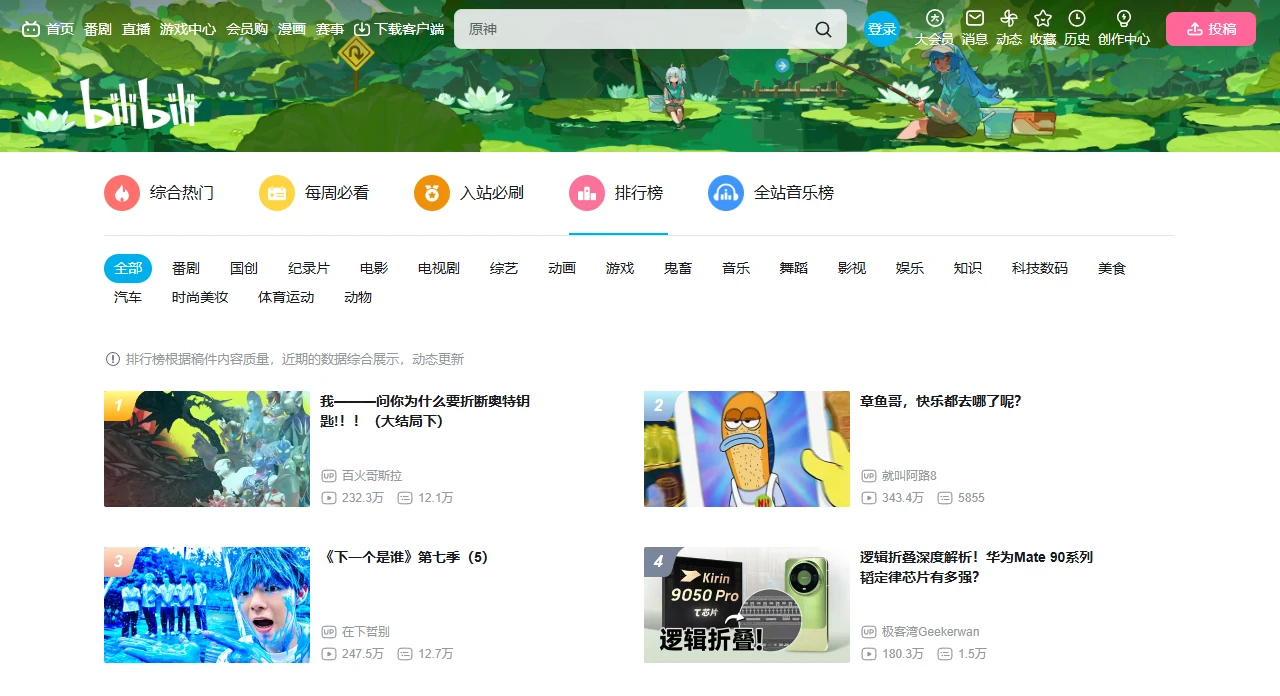
 Bilibili Rankings
A practical list entry for digging high-quality content on Bilibili.
官方Sites:https://www.bilibili.com/v/popular/rank/all
Usually, browsing Bilibili is a bit of a headache; scrolling through the recommendation page either shows clips of old anime you’ve already watched or uninformative ad videos. If you want to find content that people actually think is good, you either have to search or take a chance. Later, I accidentally found an entry dedicated to aggregating content recognized by the platform’s users, which saved me a lot of wasted time scrolling through recommendations.
The biggest pitfall for beginners is thinking that this ranking is “the most popular content on the entire platform”, so you click in and wait for the top spots on the overall rankings, only to find they are all entertainment-related hits, and you can’t find practical or professional content if you want it. Some people also fixate on the view count, thinking high views mean good content, but in reality, many high-view videos rely on clickbait or short, quick traffic to attract views, and the quality of practical content lags behind.
In my experience, the most practical part of this entry is that it brings together content that users are actually willing to spend time digesting and interacting with, not what the algorithm shoves in your face — it’s built on real user behavior data. For example, I usually like to check tech-related content; instead of scrolling through the recommendation page for a long time and stepping on pitfalls, I can directly select the tech category ranking, where the videos are all genuinely valuable to people in the same field, not fake data bubbles created by views.
In terms of sub-functions, what impresses me most is that each video comes with details like the number of bullet comments and comments, not just a cold view count. Sometimes a video doesn’t have the highest view count, but the bullet comments are dense; when you click in, you find that the UP creator talked about a niche but practical skill, like how to adjust camera parameters or choose a laptop. This kind of content can’t be pushed out on the recommendation page at all, but can be accurately found in the rankings.
Compared to popular content entries on other platforms, this place has obvious advantages. Other platforms either mix all content together, with categories as vague as an unorganised wardrobe, or the data has a lot of water, with obvious traces of view fraud. The interaction data here is more genuine; for example, the ratio of bullet comments to views: if a video has a million views but only a few thousand bullet comments, it’s probably bought views; but if it has hundreds of thousands of views and hundreds of thousands of bullet comments, it’s definitely real popularity — content that people are willing to stop and discuss.
Let me share a big pitfall I stepped on: when I first started using it, I thought the overall rankings covered all fields, so I waited for several days and found the top twenty were all variety shows and meme videos, and I couldn’t find the tech content I wanted at all. Later, I found that each category has its own separate rankings, such as anime, knowledge, music, meme videos, and even entertainment, fashion, etc. If you want to find content in a specific field, you can directly go to the corresponding category rankings, which is way more efficient than scrolling aimlessly.
Another small trick: now when I browse, I focus on bullet comment density, like whether there are a large number of bullet comments in the first few minutes of the video, which shows that people found it interesting right away, not a boring, filler-style video that drags on. Also, don’t just look at the top spots; sometimes really good content is hidden in the middle of the rankings, like an in-depth analysis by an UP creator. The view count might not be that high, but the quality is way better than the ad videos in the top spots.
Who is this entry suitable for? For example, people who don’t have much time to scroll through recommendations and want to quickly dig up high-quality content; for enthusiasts in a certain field who want to know what everyone is discussing and find content for like-minded people; and for people like me who hate that the recommendation page always pushes duplicate content and want to find new videos in a different way.
Occasionally there are exceptions, such as individual content that rides on trends in the category rankings. In such cases, you can check the pinned discussions in the comment section; user feedback is the most accurate basis for judgment, more reliable than simple interaction data. After all, even the most genuine interaction data can’t avoid a few people leading the charge, and real discussions from ordinary users are the core measure of content value.