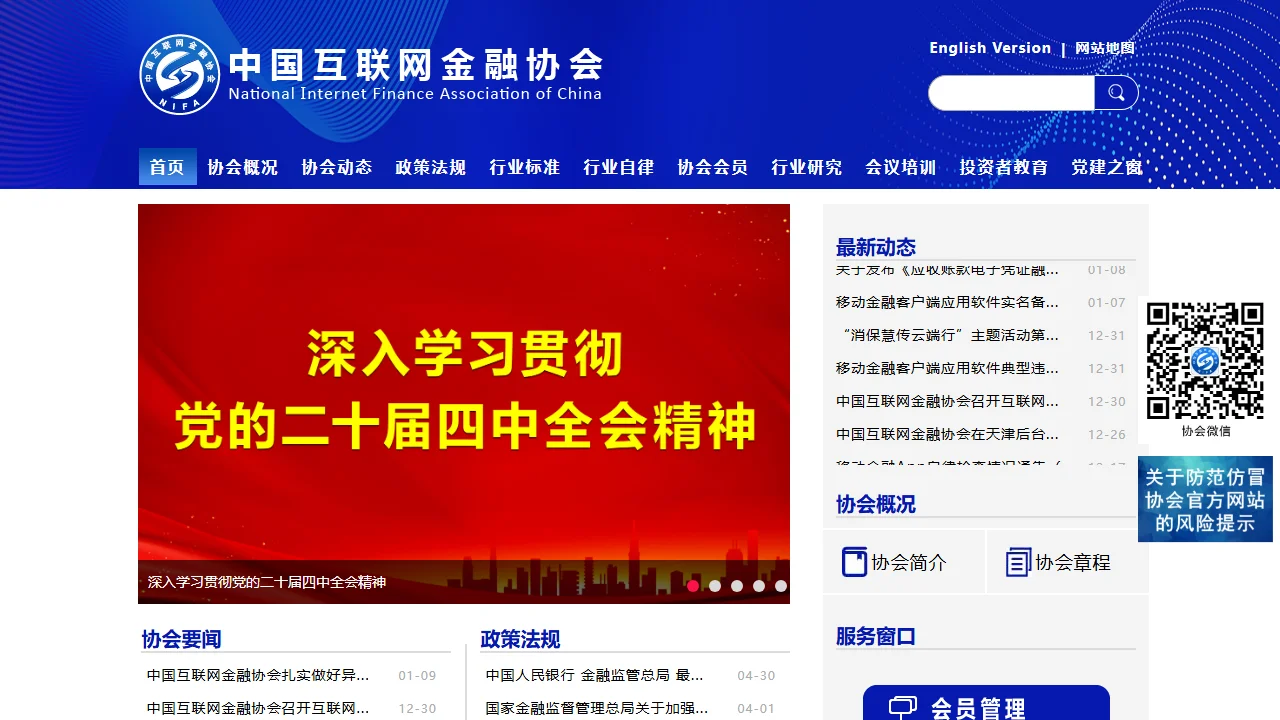
Screenshots

When an online lending link suddenly pops up while you’re browsing on your phone, can you really trust it? If you want to look up an Internet finance product, is there an official regulatory basis for it? When faced with such questions, many people instinctively look for a practical point of reference — and the National Internet Finance Association of China is the core reference everyone can turn to.
First, Get Clear on Your Needs
Official website: https://www.nifa.org.cn/
Many people first heard of the association on 25 March 2016, the day it was officially established. Initiated by the People’s Bank of China and approved by the State Council, it is a nationwide, industry-wide, non-profit social organisation. Its first president was Li Dongrong, a former deputy governor of the central bank, and its members cover the whole chain from traditional finance to emerging Internet finance.
Its membership list has no threshold-style divisions: it includes traditional financial institutions familiar to everyone, such as banks, securities firms, insurers, fund companies and trusts, as well as emerging business forms like Internet payment, online lending, Internet wealth management and crowdfunding. In effect, all Internet-finance-related institutions are brought into the same regulatory framework, so different business forms do not end up with separate sets of rules.
Sort Out What You Can Actually Use It For
Many people’s impression of the association stops at “the body that regulates the industry”, but in fact most of what it does starts from practical needs.
Its most fundamental job is setting rules for the industry, including operational and management rules as well as technical standards. It also promotes business exchange and information sharing among institutions to avoid the risks caused by each acting on its own with no information flow — for example, the standards for information exchange between different payment institutions were finalised under its leadership.
In addition, it builds self-regulatory disciplinary mechanisms. Rather than relying on rigid administrative orders, it regulates market order through industry-internal constraints, strengthening the actual binding force of the rules so that practitioners dare not cross the line lightly. For example, for non-compliant online lending institutions, it first issues industry notices urging rectification instead of shutting them down outright.
It also guides practitioners to strengthen their awareness of lawfulness, integrity and self-discipline, organising and urging members to implement relevant national policies and ensuring the industry’s direction of development stays aligned with national strategy and does not go astray. For example, in response to the requirement that finance should serve the real economy, it organises members to connect with the financing needs of real-economy enterprises.
Another very practical task is protecting the legitimate rights and interests of members by building platforms for dispute resolution and complaint handling and improving service quality across the industry. At the same time, it carries out industry research and talent development, promoting a balance between innovation and risk prevention and control, so the industry does not focus solely on making quick money while ignoring risks. For example, ordinary users who run into an Internet finance dispute can submit a complaint through this platform, which is more reliable than hunting for scattered channels.
Down to Concrete Use Scenarios
The existence of this association has, in effect, filled the gap in self-regulatory management of the Internet finance industry. When the industry was growing wildly, there were no unified rules; now that it is in place, it both oversees institutional compliance and guides the industry to serve the real economy, making it an important support for the industry’s standardised and healthy operation.
If you work in Internet finance — whether in the online business of traditional finance or in an emerging business form — you can find the corresponding regulatory requirements in this association, and you can also use it to connect with industry resources. For example, if you want to launch Internet wealth management services, you can look up the unified information disclosure standards on the association’s official website.
If you are an ordinary user who runs into an Internet finance dispute, you can also file a complaint and defend your rights through its platform. For example, if you encounter violent debt collection by an online lending institution or a wealth management platform failing to honour payments as agreed, a dedicated person will follow up after you submit the complaint, so you don’t have to look for channels everywhere yourself.
- To check whether an Internet finance institution is compliant, log in to the association’s official website and verify the institution’s credentials in the membership list
- To file a complaint about a financial dispute, find the corresponding dispute resolution entry on the official website and submit your materials
- To learn about the latest industry rules, check the policy announcement section on the official website for the latest regulations