Bioon
Biomedicine New Media Portal
 Ants Web
The world's largest professional Chinese-language ant website
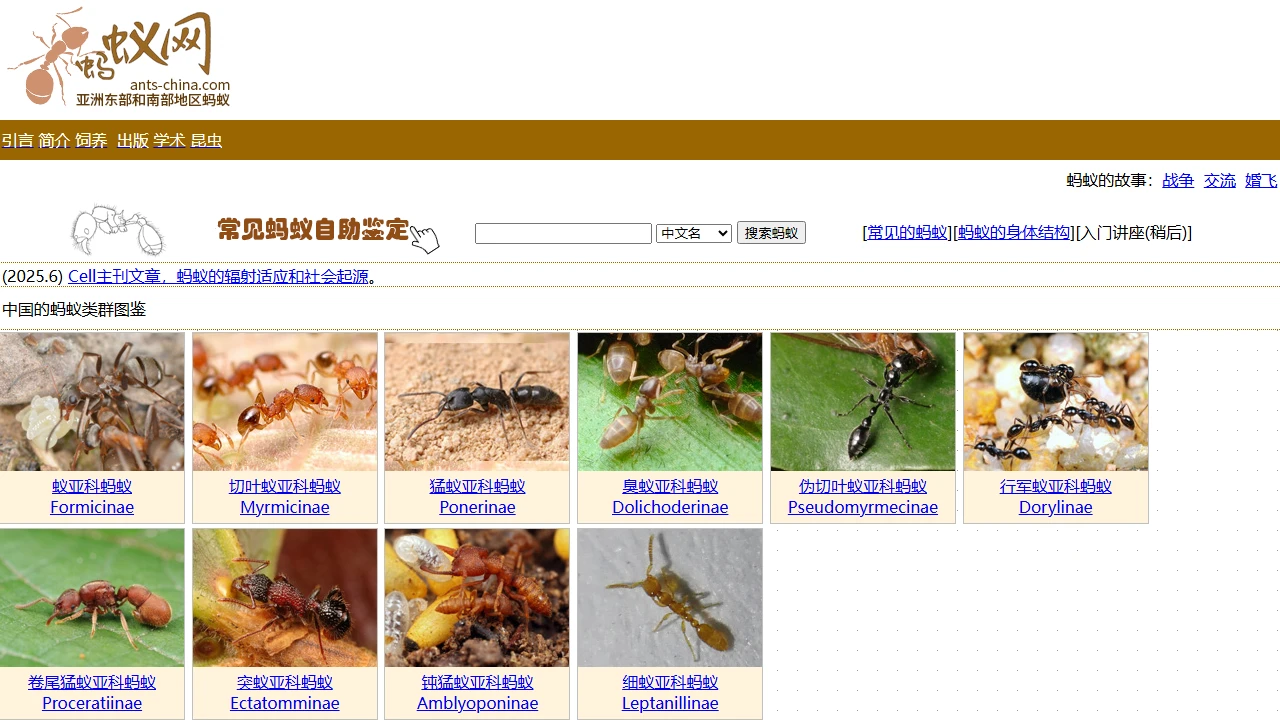
When I first got into ant keeping, the silliest pitfall I fell into was following scattered tips from search engines and keeping native harvester ants together with house ants — the small nest I had just set up crashed within three days. It was only after an experienced keeper pointed the way that I found a reliable home base — Ants Web, known among insiders simply as the Ant Web. It is the core platform under Species Web dedicated to ant science popularisation and sharing, and currently the world’s largest professional Chinese-language ant site. Focusing on ants of East Asia, Northeast Asia, South Asia and Southeast Asia, it has built a genuinely solid platform for fellow enthusiasts to exchange and learn.
If you are only just getting a taste of ants, don’t rush to buy nests and ants at random — head straight for the beginner-only basic husbandry section. It breaks down nest building, food preparation, and temperature and humidity control in fine detail, with real photos for every step — for example, how to piece together a well-ventilated ant nest out of acrylic panels, or how to prepare sugar water in the right amounts for different ant species. Even common beginner mistakes are flagged — for instance, don’t feed harvester ants mealworms that are too wet, or they will spoil easily.
There is also a Q&A section — don’t be shy about asking. The regulars there are all veteran keepers with three to five years under their belts. Last time I asked “Why do my jumping ants always hide and never come out?”, within ten minutes someone sent me a video of his own jumping ants, suggested the nest might be too bright, and told me to cover it with a black box. The problem was sorted within two days.
Official Website: http://www.ants-china.com/
Once you have the basics down, it’s time to browse the species atlas section, which holds information on nearly a thousand ant species across Asia — from scientific names to distribution, from appearance to habits, complete with high-definition field photos and laboratory observation shots. Last time I was looking for distribution records of native harvester ants, I came across user uploads from the Gaoligong Mountains in Yunnan, and even saw someone had attached their own nest temperature measurements — far more reliable than groping about on my own.
If you love field observation too, don’t miss the field observation resource library, which has built up ant records from forests, farmland and city parks, along with observation routes shared by users — for example, under the camphor trees in a certain Hangzhou park, pavement ants tend aphids for honeydew every early summer. Follow leads like these and you can catch fascinating scenes without wandering about aimlessly.
Once you have been at it for a few years, it’s time to dig deeper. The platform’s forum often runs themed discussions — last month’s topic, for instance, was “the relationship between the social division of labour in ants and colony density”. Some members posted data on how their colonies had changed over two years of keeping, others shared behaviour observation sheets they had drawn up, and even abstracts of papers by overseas researchers were translated and posted. You can pick up plenty of serious research thinking.
I have also seen people share their own ant science mini-videos here, explaining to children in their neighbourhood how ants find food and helping to correct the misconception that “all ants bite”. Veteran keepers have also gathered to discuss how to standardise colony selection and avoid buying diseased colonies — a useful wake-up call for the whole ant-keeping community.
Honestly, the most precious thing about this site is that nobody talks big. All the content has been built up, piece by piece, by keepers and researchers. Even niche ant species — the giant marauder ants of Southeast Asia, say — have user-uploaded observation records, which makes it far more reliable than those science sites that just copy from one another.