UTOimage
A Korean one-stop high-quality design asset download website
 Scan to visit on your phone
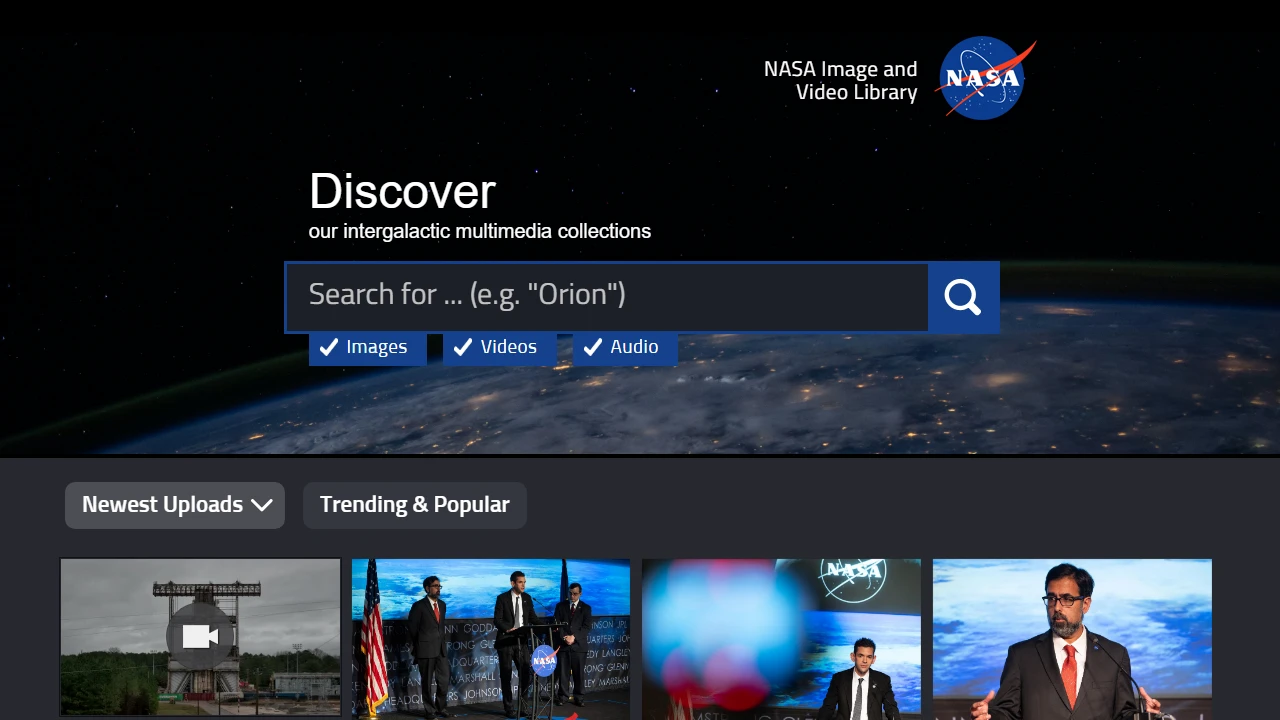
 NASA Image
Cosmic scenery images
For astronomy enthusiasts, science communicators, or ordinary fans of space exploration, NASA Image and Video Library is an essential resource platform. As the official multimedia library under NASA, the National Aeronautics and Space Administration of the United States, it brings together a massive collection of imagery from space missions, astrophysics, Earth observation and other fields. All content is available for free download and use, making it an authoritative channel for high-quality cosmic visual material.
Official website: https://images.nasa.gov/
Unlike the scattered content of niche science sites, NASA Image and Video Library draws on decades of space data accumulated by NASA, integrating more than 140,000 images, videos and audio files across over 60 dedicated collections, covering many key areas of human space exploration. Whether it’s the breathtaking moment of a rocket launch, close-ups of extraterrestrial surfaces sent back by probes, panoramic Earth views captured by satellites, or simulated footage of black hole activity, you can find the corresponding material on this platform — its professionalism and richness far exceed those of similar unofficial sites.
Beyond the diversity of content types, the platform also offers practical download options. Users can choose files of different sizes and resolutions according to their needs, and can view the complete metadata of each item, including EXIF camera data, mission background descriptions and more — a highly practical feature for educators and content creators who need to accurately credit their sources. Moreover, since its launch in 2017, the platform has clearly positioned “supporting science education and information dissemination” as its core mission: all downloaded content can be freely used for non-commercial display and creative work, with no additional authorisation required.
Many users in China experience slow loading times when visiting NASA Image and Video Library for the first time, mainly because its servers are located overseas. With this in mind, mastering a few simple tips can greatly improve access efficiency and help you find the cosmic imagery you need faster.
For educators, the NASA image library is especially valuable: for classroom space science presentations, astronomy club event posters, or materials for youth science videos, you can find high-quality content that meets your requirements here, ensuring authoritative material while saving a great deal of time in the creative process.
Behind every item in NASA Image and Video Library lies a real space mission and scientific discovery, making it not just a material download platform but also a visual window into space science. For example, you can use images of the Martian surface taken by probes to gain an intuitive understanding of the red planet’s terrain; use monthly satellite images of Earth to witness how climate change alters its surface; or use black hole simulations to grasp cutting-edge theories in astrophysics.
It is worth noting that the platform’s content updates keep pace with NASA’s latest mission progress: whenever major events such as rocket launches or probe landings occur, the related imagery is uploaded immediately, ensuring users can access the most cutting-edge cosmic visual material.