
Class Central
A globally renowned online course search engine and learning platform with over 100,000 courses indexed, covering more than 50 education platforms including Coursera, edX, Udacity, FutureLearn, and Udemy
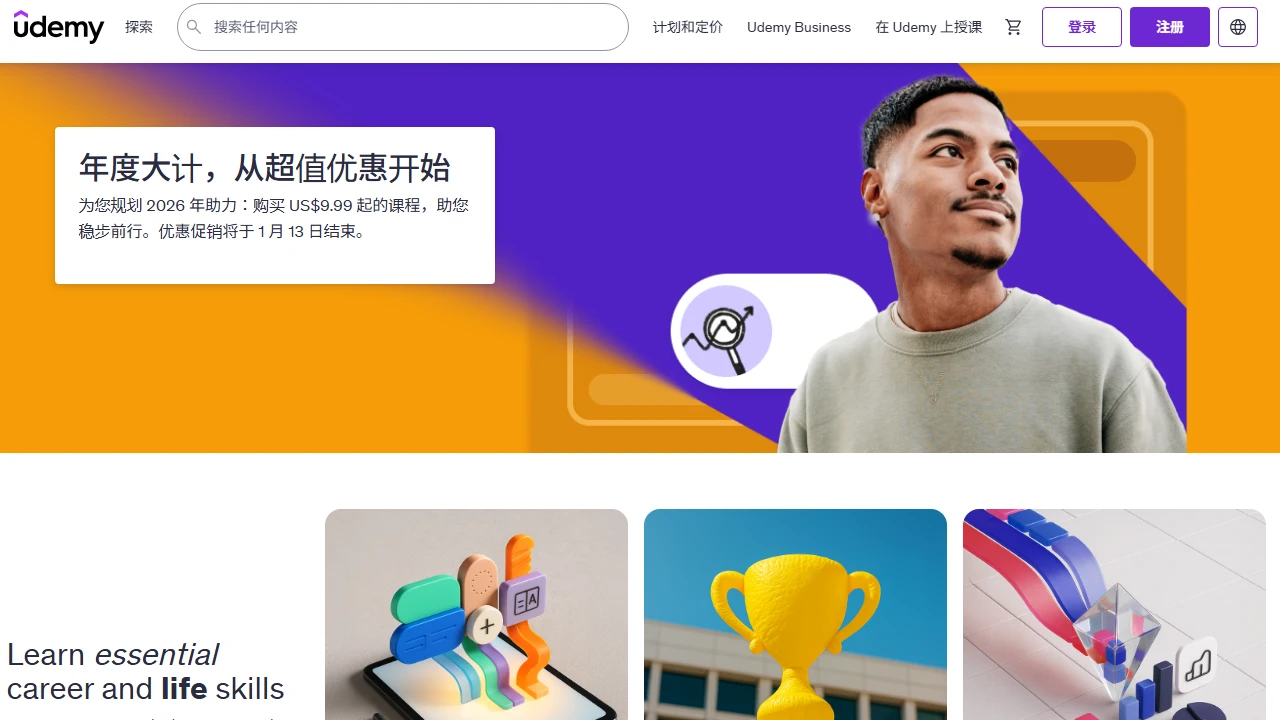
 Udemy
Courses include programming, marketing, data science, and more
Want to learn programming, operations, or photo and video editing but put off by the high costs and fixed schedules of offline training? Udemy is likely the large online learning marketplace built for such needs. This platform connects knowledge providers and learners worldwide, with hundreds of thousands of courses and tens of millions of students. Whether you are a professional looking to upskill or a creator wanting to monetise your skills, you can find your place here.
Udemy was founded in 2010 and is headquartered in the US, a global online learning and teaching marketplace. Unlike traditional online schools where content is uniformly produced by institutions, Udemy follows an open market model: anyone can enrol in courses to learn, or become an instructor to publish their own courses. After years of development, the platform has over 250,000 courses and 73 million students, covering a very wide range of professional and life skills.
Official website: https://www.udemy.com/
From the perspective of course categories, Udemy’s content spans almost both hard professional skills and leisure interests:
In terms of charging models, Udemy’s courses are both free and paid. Instructors can set their own course prices, usually between $20 and $100, and creators will receive a portion of the sales revenue after the course is sold. This mechanism not only reduces learners’ trial-and-error costs, but also gives high-quality content creators the motivation to keep producing.
Udemy’s course content is categorised by topic, and the videos adopt a modular design. Students don’t have to listen from start to finish; instead, they can directly locate the corresponding chapters for their weak areas. For office workers with tight schedules, this “click where you don’t know” learning method is much more friendly than a two or three-hour long video.
Many people give up halfway in online learning due to a lack of feedback. Udemy encourages instructors to integrate interactive elements such as assignments, quizzes, and forums into their courses: quizzes can timely test mastery, while forums allow students to ask questions, communicate, and encourage each other. When engagement increases, learning outcomes are more likely to be achieved.
In addition to the web version, Udemy also provides iOS and Android apps. Learners can arrange their progress at their own pace, without being limited by time, location, or device. Watch a video during commute, complete a quiz during lunch break, and finish assignments when you get home at night — fragmented time can be pieced together to form a complete learning path.
The biggest difference between Udemy and other online education platforms is that it not only opens courses, but also opens teaching opportunities. As long as you have solid professional ability in a certain field and are willing to share, you can create your own course on the platform and introduce your expertise to students around the world. Course fees are set by instructors, with revenue split proportionally, which has a very low threshold for creators who want to monetise their knowledge.
If you plan to start your instructor journey on Udemy, you can refer to the following ideas:
An open platform means two-way opportunities: when more people learn, instructors also have a stable stage; the more professional the instructors are, the more substantial the gains for learners.
Udemy’s services do not stop at individual learners. For organisational training needs, the platform has launched Udemy for Business (UFO), an online learning product for enterprises, providing customised training solutions and various training courses and services to help enterprises systematically improve employees’ skills. For companies that need to improve team capabilities in batches and do not want to build their own training system, such ready-made enterprise-level solutions save time and effort.
Udemy’s courses are usually priced between $20 and $100, set by instructors. At the same time, there are a large number of free courses on the platform. Learners can completely test the waters with free content first, and consider paid advanced courses only after confirming that the teaching style suits them.
Yes. The core logic of the platform is that anyone can teach. It values more whether you have real professional ability in a certain field and whether you can organise content into well-structured modular videos. With interactive designs such as assignments and quizzes, new instructors can gradually create popular courses.
Whether you are a learner who wants to upskill yourself, or a future instructor who wants to share your expertise, you can first visit the official website to browse the course catalogue, start with a content you are interested in, and personally experience the openness and flexibility of this global online learning marketplace.