Kanxue Academy
Security Training Courses
 Runoob
A website offering basic programming technical tutorials
Many people first encounter Runoob through a search: they want to look up the syntax of an HTML tag, or are unsure how to use a certain Python function. After typing in the keywords, the page from runoob.com often appears at the top of the results. This Chinese website focused on basic programming teaching has organised entry-level knowledge of mainstream languages and technologies such as HTML, CSS, JavaScript, Python, Java, Ruby, C, PHP, MySQL into clear learning paths, so that both absolute beginners and developers wanting to brush up on basics can find what they need.
Official Website: https://www.runoob.com/
Unlike many purely document-style sites, it values “doing after understanding” highly: a large number of knowledge points are accompanied by runnable online examples, where the code runs directly in the browser, with results visible immediately, without the need to set up a local environment first. For beginners, this instant feedback is the most direct way to build confidence.
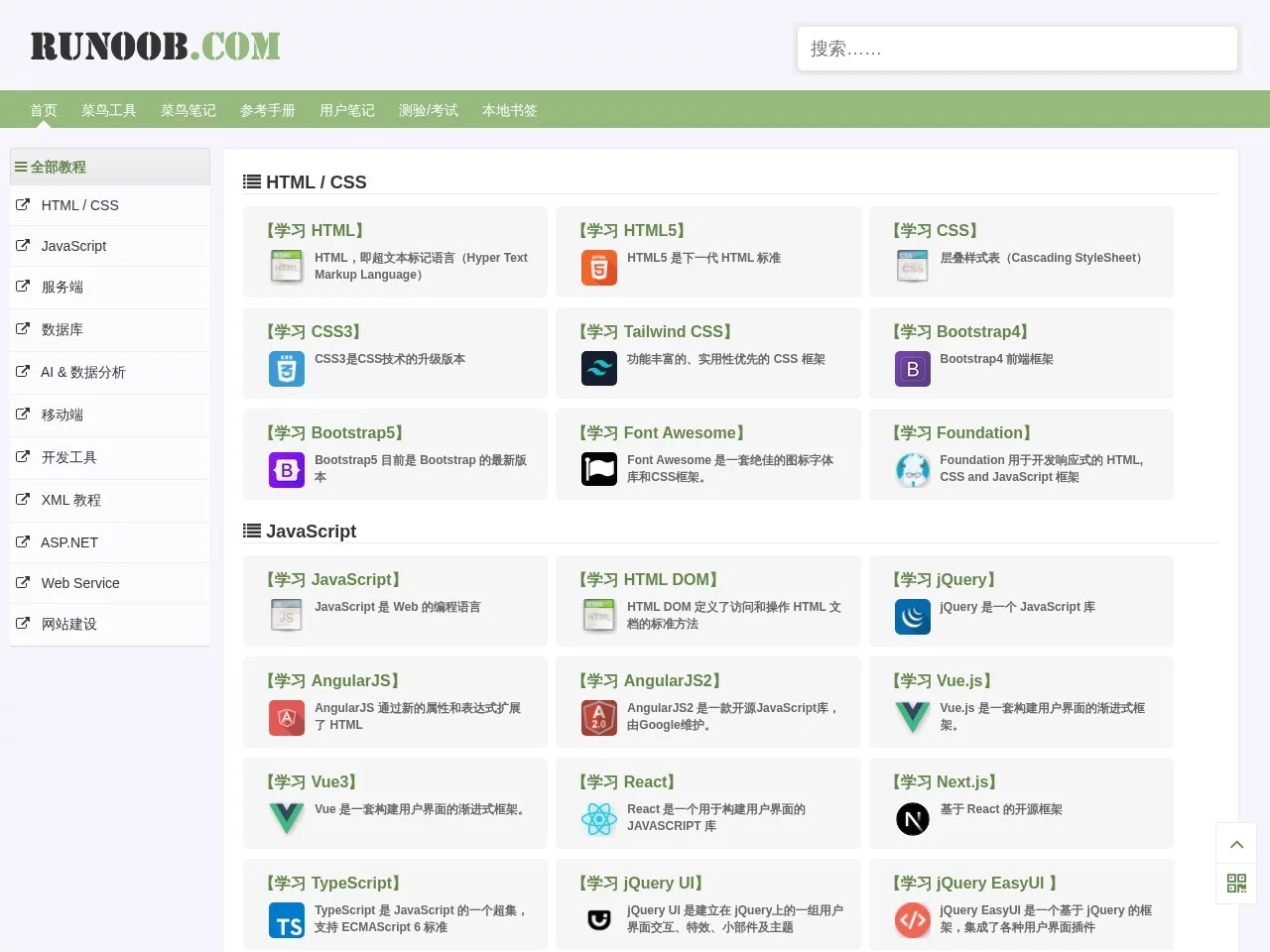
If you map out the content of Runoob, you will find it covers almost every stage a beginner goes through, from web pages to servers, from data storage to mobile apps — you can find corresponding entry-level tutorials for common development directions:
The value of this “one-stop” organisation lies in smooth connection: after learning front-end, you can transition to back-end directly; after mastering a language, you can then learn databases — no need to jump between several scattered websites, making it easier to form an integrated knowledge system.
Online examples are the most popular part of this site. The code examples in the tutorials can be viewed and run directly. Change a parameter or rewrite a line, and the result refreshes immediately. For abstract concepts like syntax, instead of repeatedly reading written descriptions, it’s better to “test and learn” a few times — this way, the impression is much deeper.
If you prefer to study materials at your own pace, Runoob also supports downloading all entry-level tutorials, and offers two reading formats: HTML and PDF. During commutes or in environments without internet, you can still follow the downloaded documents at your own rhythm, so that fragmented time won’t go to waste.
Run examples online first, then revise offline — using both methods together is often more efficient than relying on a single path.
The Python entry-level tutorials on the site cover everything from introduction, environment setup, Chinese encoding issues to basic syntax, and also delve into some commonly used modules, helping readers understand the practical applications of Python, with a fairly complete coverage. But please pay special attention: this set of tutorials is mainly targeted at Python 2.x. If you have Python 3.x installed on your computer, please refer to the corresponding 3.x version tutorial on the site — otherwise, you are likely to encounter pitfalls in syntax details due to version differences.
The CSS section has compiled a complete list of properties, selector syntax and support status across browsers. Through systematic explanations, it teaches readers to use CSS to control the styling and layout of multiple web pages. Follow the chapters in the entry stage, and use it as a reference manual when advancing — both uses are very convenient, and after mastering it, the improvement in web development efficiency is obvious.
The Android tutorial is designed specifically for beginners with no development experience. It progresses from development environment to basic concepts, with a gradual pace, suitable for learners who want to enter the mobile field to follow chapter by chapter. There’s no need to rush through chapters — laying a solid foundation will make things much easier later.
The content of Runoob was originally translated from w3schools.com, but it is not a simple copy. It has been retypeset, with a high overall structure and reading quality, more suitable for Chinese users’ reading habits. The operator checks user feedback every day, corrects content and moderates site notes, and improves the site through continuous iteration. Of course, for such a large tutorial platform, content updates inevitably face challenges. The founding team is clearly aware of this and has stated that they are willing to keep improving.