51CTO Academy
IT technology course learning
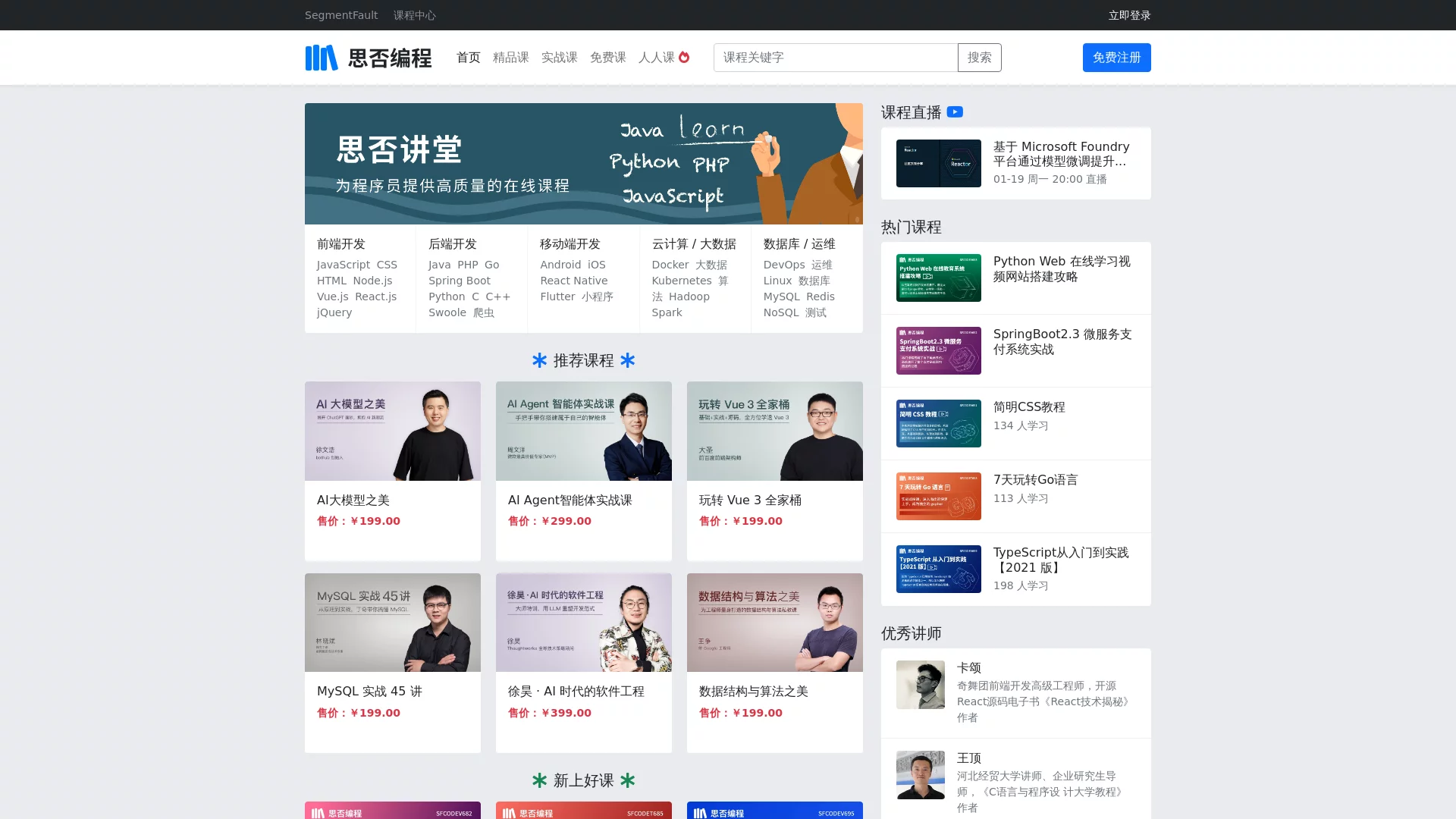
 SegmentFault Programming
Committed to helping learners better master programming, enhance technical knowledge, achieve breakthroughs in professional competence, and get promoted and pay rises.
Before talking about SegmentFault Programming, we need to mention its parent body, the SegmentFault Community. This community has long been among the top developer communities in China, adhering to pure and high-quality technical exchanges, with businesses spanning four lines: Technical Q&A, Technical Columns, Technical Courses, and Information Services. For many years, it has accompanied the growth of a large number of Chinese programmers. It is in such an environment that the SegmentFault team has incubated an online professional skill learning and improvement platform for the IT field — SegmentFault Programming, aiming to build a real online technical practical university, helping learners master programming, enhance technical knowledge, achieve breakthroughs in professional competence, and even get promoted and pay rises.
Official Website: https://ke.segmentfault.com/
Different from many online education products that emerge out of nowhere, SegmentFault Programming comes with community attributes: it knows exactly where developers get stuck and what kind of answers are reliable, so the courses and community content are naturally connected. The platform collaborates with front-line Internet technical experts to teach, covering mainstream technical directions such as Front-end, Java, Python, PHP, Vue, and stringing scattered knowledge points into a systematic learning path.
When opening the course list, the first categories you see are Premium Courses, Practical Courses, Free Courses, and Universal Courses. Many beginners will be confused: what are their differences? In fact, these four types of courses correspond to different learning stages and budgets. Find your own position, and choosing courses will not be tangled.
Haven’t decided whether to delve into a certain direction? Try the free courses first. It is open with zero threshold, allowing you to intuitively feel the instructor’s teaching style and content rhythm, then decide whether to invest more time and money. Universal Courses are also friendly to the threshold, covering a wide range of people at a lower cost, suitable for developers with limited budgets who want to get improvement opportunities.
After determining the direction, there are two routes to choose from:
One takes root downward, the other lands outward, and the combination of the two often works better: first use Premium Courses to clarify the principles, then use Practical Courses to test the mastery, so that knowledge can truly be internalized.
From the technical landscape, the courses span multiple fields such as Front-end Development, Back-end Development, Data Mining, Artificial Intelligence, and both beginners and advanced learners can find corresponding content. Several representative courses are enough to illustrate its course selection ideas: Concise CSS Tutorial helps front-end newcomers get started quickly, TypeScript from Beginner to Practice follows the mainstream trend of typed JavaScript, and Node.js Advanced Practical Course is for programmers who want to delve into server-side development.
The common feature of these courses is the adherence to the word “practical”. The content does not stop at listing grammar and explaining concepts, but is organized around real development scenarios, so that each lesson can answer “how to use this technology in work”. This is in line with the positioning of SegmentFault Programming as an “online technical practical university” — applying what you learn is the starting point of course design.
Courses solve “what to learn and how to learn”, while the SegmentFault Community answers “where to go after learning”. Combining the two makes the growth path complete. Beyond the classroom, these resources are worth bookmarking:
Yes. First use free courses to build an overall understanding of programming, then choose an introductory course to learn step by step. When encountering obstacles, you can always go to the technical Q&A area for help, and there are always enthusiastic people in the community to respond.
For on-the-job developers, it is recommended to choose practical courses based on job requirements: front-end developers can focus on TypeScript and Vue-related content, back-end developers can delve into Node.js practical courses. The skills learned can directly feed back to daily projects, with the highest input-output ratio.
Yes. Premium Courses can be used to fill knowledge gaps; Technical Columns are suitable for outputting experience and participating in discussions; Hackathons are good opportunities to verify creativity and continuously accumulate technical influence.
The true value of a learning platform never lies in the number of courses, but in whether it can provide a complete path from beginner to advanced, from personal study to community communication. SegmentFault Programming has just laid this path: there are systematic practical courses in the front, and an active community ecosystem in the back. Whether you want to solve a tricky technical problem, master a new skill, or simply participate in a high-quality technical discussion, you can start steadily from here at your own pace.