
Curator
Curator is an AI-powered knowledge base Q&A assistant designed to help users efficiently manage and utilise knowledge.
 Winston AI
An industry-leading AI content detection and plagiarism checking tool
When generative tools like ChatGPT, GPT-4, Google Gemini and others permeate every aspect of writing, the question “Is this piece written by a human or generated by a machine” has become an unavoidable issue for editors, teachers and content teams. Winston AI is an industry-leading AI content detection and plagiarism checking tool, designed specifically for academic institutions, SEO professionals and content creators. It can accurately identify texts and images generated by mainstream large models, with an official detection accuracy rate of up to 99.98%, while keeping the false positive rate at an extremely low level.
The writing level of generative AI is already sufficient to pass ordinary visual inspection. Relying solely on manual judgment to determine the source of a manuscript is both inefficient and unreliable. Winston AI delegates this problem to algorithms: the system analyzes the language patterns, syntactic structures and statistical features of the text, and outputs a quantified probability of AI generation, so that reviewers no longer need to draw conclusions based on subjective feelings.
Official website: https://gowinston.ai/
Unlike many similar tools that only perform “rough judgments”, Winston AI emphasizes high accuracy and low false positive rate in parallel. For scenarios that require extremely high seriousness of conclusions, such as academic journals and news organizations, misclassifying original human works as machine writing may be more costly than missing detection — this is exactly why it takes low false positive rate as its core selling point.
The combination of these three functions means that users can complete three checks on the same platform: “Is this written by AI?”, “Is there plagiarism?” and “Is the accompanying image synthetic?” They don’t need to switch between multiple tools, nor run separate processes for each manuscript.
This is especially important for SEO teams operating multiple content sites: search engines have become increasingly strict about low-quality bulk-generated content. Using Winston AI to “check up” on manuscripts before they go live can effectively reduce the risk of the entire site being penalized due to association.
It can be seen that these scenarios have one thing in common: the judgment of content source must be reliable and traceable. Whether it is a supervisor grading a paper or a legal officer reviewing a document, the conclusion given by the detection tool will directly affect subsequent decisions — this is also the practical significance of Winston AI achieving an accuracy rate of 99.98%.
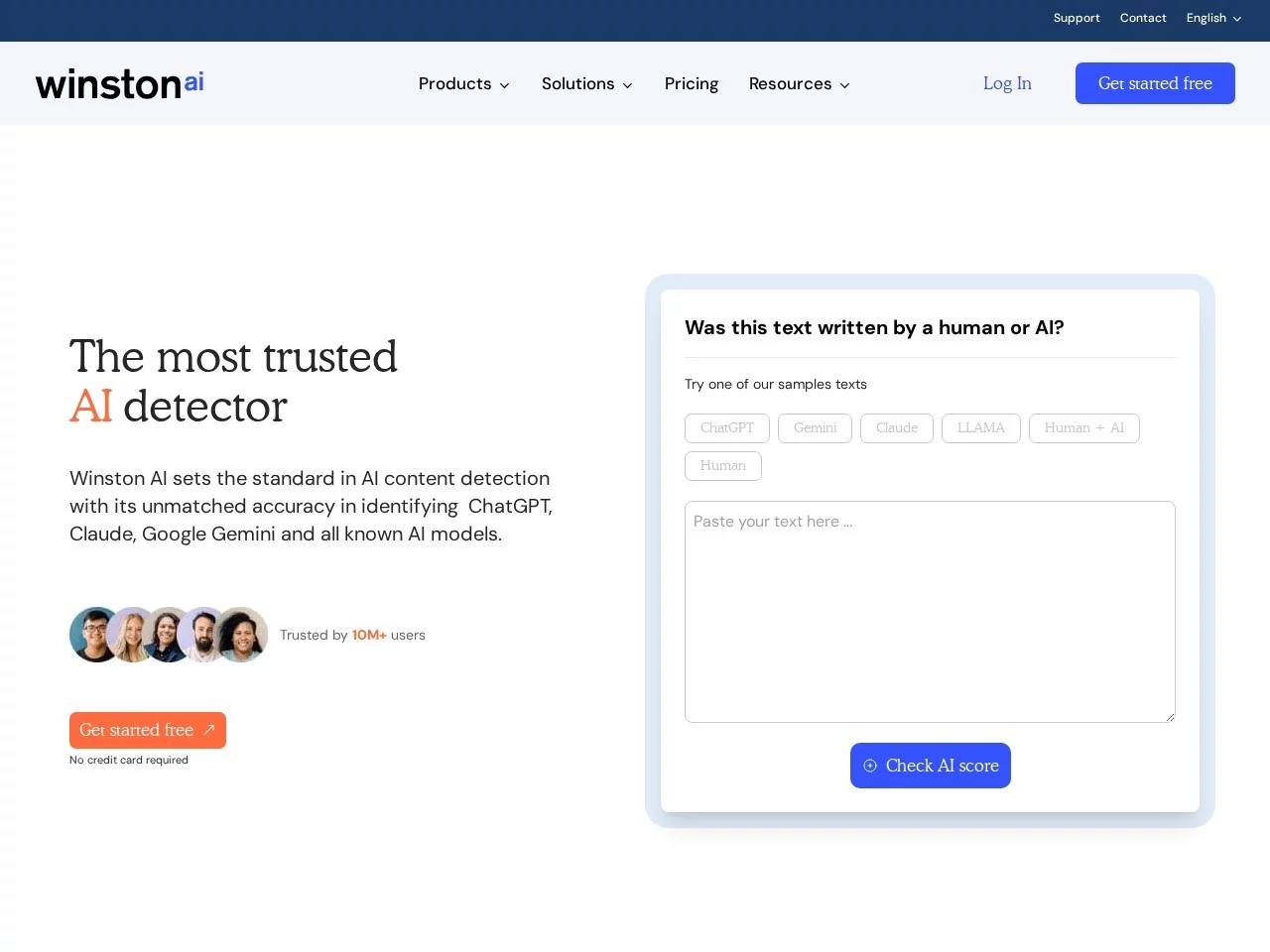
The interface design of Winston AI is simple and intuitive. Just paste the content to be detected to start analysis, and the results are presented in a clear form. The platform also has detailed operation guides and provides real-time customer support. If you encounter problems, you can consult directly, so even first-time users won’t get lost.
No detection technology can promise absolute accuracy. Winston AI’s strategy is to minimize the false positive rate, so that original human content is as unlikely as possible to be misclassified. In actual use, it is recommended to take the detection results as one of the reference bases, and combine manual review to form the final conclusion — this is also the common practice in academic and publishing institutions.
With the popularity of AI drawing tools, the risk of forged accompanying images and synthetic photos is no less than that of text rewriting. Winston AI’s AI image detection function is designed specifically for this trend, and is a practical supplement for links such as news accompanying image review and material copyright control.
From classrooms to editorial departments, from copyright owners to legal departments, wherever there is a need to endorse the authenticity of content, Winston AI provides a ready-made technical solution — with three checks on text, images and plagiarism, the question “Is this content credible?” is no longer an unresolved issue.