Rytr
An AI-powered writing assistant platform designed to help users complete writing tasks efficiently by automatically generating text content
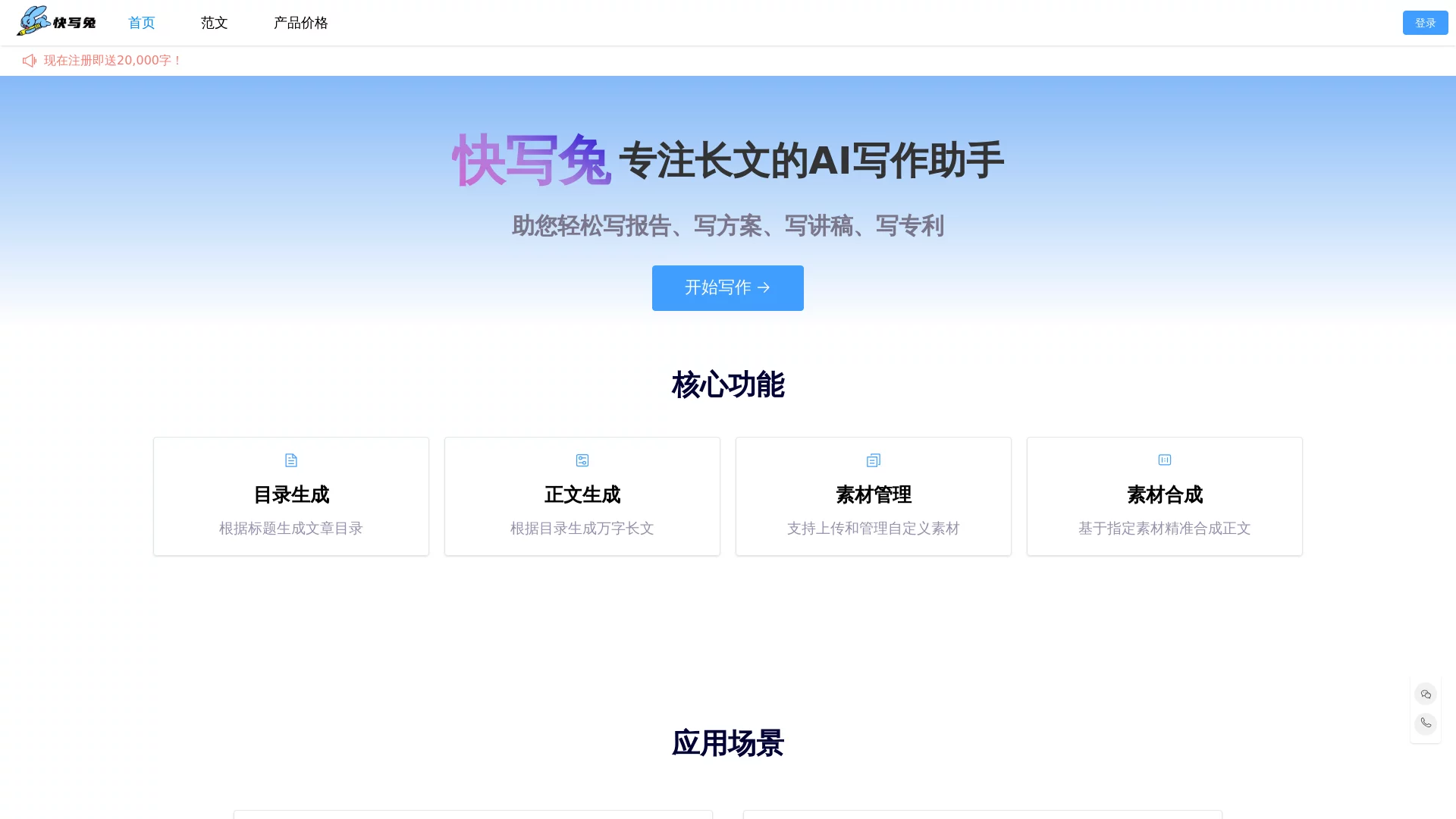
 快写兔AI写作
Long-form AI writing assistant that can generate table of contents and main text with one click, helping you easily write reports, proposals, speech scripts, and patent d...
For long-form writing tasks that often run into thousands or even tens of thousands of words, many people get stuck at the first step: not knowing where to start. KuaiXieTu AI Writing is an AI writing assistant specifically designed for long-form writing scenarios. It is trained on a domestic ChatGPT large model, integrating core functions such as intelligent table of contents generation, main text content generation, and material integration. From work reports and business proposals to speech scripts and patent documents, it can help users efficiently complete first drafts of long articles with tens of thousands of words, effectively lowering the threshold for in-depth writing.
The pain points of long-form writing usually focus on three stages: first, building a framework — you have a topic but don’t know how to structure the chapters; second, finding materials — your arguments need supporting evidence, but resources are scattered and hard to gather; third, sustaining output — you often run out of ideas halfway and the writing style becomes inconsistent. These three stages exactly correspond to the three core capabilities of KuaiXieTu AI Writing: intelligent table of contents generation solves the “structure” problem, material integration solves the “content source” problem, and main text content generation fills each section paragraph by paragraph to form a complete article.
Unlike general-purpose conversational AI, this tool is positioned specifically for “long-form writing”. What users input is often not a simple question, but a topic, outline, or reference material. The system plans a complete table of contents based on this, then expands each section, and finally delivers a complete first draft that can be directly edited and modified, rather than fragmented Q&A snippets.
Official website: https://www.kuaixietu.com/
Based on its product positioning, the following types of tasks best leverage its strengths, with different operational approaches.
When writing work reports or industry reports, simply provide the table of contents framework and relevant reference materials, and the system can quickly produce a complete first draft. The task that originally took days to structure is compressed into three steps: “provide framework — generate first draft — polish”.
Business proposals require multi-angle comparison. By providing the proposal outline and background materials to the tool, you can get multiple first drafts in a short time. Users can compare the entry points of different versions horizontally and pick the most suitable one to further refine.
Speech scripts test structural sense the most. After inputting the speech topic, the tool automatically builds the chapter structure of the script and generates the main text paragraph by paragraph, from opening preparation to expanding viewpoints in one go, eliminating the trouble of drafting an outline from scratch.
Based on the patent name and relevant technical materials, it can assist in producing the first draft of a patent disclosure. For inventors who are not good at document expression, this function can effectively reduce the writing burden, allowing them to focus on the technical solution itself.
These three points together form its core advantage over ordinary writing tools: model optimization determines “how well it writes”, template-free design determines “how easy it is to use”, and the removal of the word limit determines “whether it can handle truly 10,000-word long-form tasks”.
The upper limit of the tool largely depends on the input quality. Whether writing a report or a proposal, it is recommended to prepare the table of contents framework, background materials, and technical materials as fully as possible before submission. The more specific the information, the closer the generated content will be to real needs; if only a general title is provided, the output will naturally be too general.
This is not recommended. The AI produces high-quality first drafts, but the data, cases, and expressions still need manual verification and polishing. Especially for formally submitted reports and patent documents, it is necessary to confirm the accuracy paragraph by paragraph. Treat it as an assistant that handles most of the first draft work rather than the final product, so that both efficiency and quality can be achieved.
For people who often deal with 10,000-word long articles, KuaiXieTu AI Writing takes over the most time-consuming stages of framework building and first draft writing. Users only need to modify and improve on this basis, and the final draft time can be greatly shortened.
If your daily work relies on reports, proposals, speech scripts, or patent documents, you might as well use the writing task you are currently working on to experience the official website firsthand and see the quality of the first draft it delivers.